


Page 575 - IJB-10-3
P. 575
International Journal of Bioprinting                                         Bioprint micro breast cancer


               This unique matrix structure, while making PMCaTs   representative platform for studying these challenges.
            more physiologically relevant by mimicking the natural   The interactions between T cells and cancerous tissues
            tumor  environment,  also  poses  challenges  for  drug   in our model provide insights into their engagement
            delivery. The intricate interplay between the rigidity   and potential neutralization mechanisms. However,
            of the  matrix and  the diffusion of large  molecules  may   while the model presents a valuable foundation, it is
            elucidate some of the obstacles encountered in clinical   in its initial stages. Given the growing importance of
            settings, especially when administering antibody-based   immunotherapy, our findings highlight the need for
            therapies. Moreover, this has broader implications. The   rigorous validation, incorporation of varied immune
            understanding that PMCaTs can accurately simulate drug   cell dynamics, and evaluations in drug testing scenarios
            penetration due to their matrix composition emphasizes   to ensure the model’s relevance and applicability in
            the need for refined drug delivery techniques tailored for   therapeutic studies.
            specific tumor microenvironments.
                                                               3.8. Modeling cancer metastasis
               Going forward, these findings stress the importance of   Metastasis, the spread of cancer cells from the primary
            not only targeting cancer cells but also understanding and   tumor to distant sites, is a key factor in cancer progression
            possibly manipulating the tumor microenvironment for   and the leading cause of cancer-related deaths. 33,34  By
            better therapeutic outcomes. It might be worth exploring   focusing on the dynamics of metastasis, our study aims to
            strategies to modulate matrix rigidity or enhance drug   shed light on the mechanisms underlying cancer spread,
            penetration by changing the tumor matrix architecture,    offering potential avenues for therapeutic intervention.
                                                         28
            offering a two-pronged approach to tackle tumor resistance
            and ensure a more effective drug delivery. 29         Utilizing PMCaTs as our experimental model, we
                                                               sought to visualize and understand the dynamics of
            3.7. Modeling immunotherapy                        metastasis in a controlled environment. All PMCaTs were
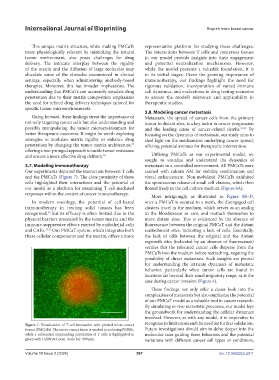
            Our experiments depicted the interaction between T cells   stained  with  calcein  AM  for  viability  confirmation  and
            and the PMCaTs (Figure 7). The close proximity of these   visual enhancement. Non-mobilized PMCaTs exhibited
            cells highlighted their interactions and the potential of   the spontaneous release of small cell clusters, which then
            our  model  as a  platform for  examining T  cell-mediated   floated freely in the cell culture medium (Figure 8A).
            responses within the context of cancer immunotherapy.
                                                                  More intriguingly, as illustrated in  Figure 8B–D,
               In modern oncology, the potential of cell-based   once a PMCaT is secured to a mesh, the disengaged cell
            immunotherapy in treating solid tumors has been    clusters travel in the medium, which serves as an analog
            recognized,  but its efficacy is often limited due to the   to the bloodstream  in vivo, and reattach themselves to
                     30
            physical barriers presented by the tumor matrix and the   more distant sites. This is evidenced by the absence of
            immune-suppressive effects exerted by endothelial cells   fluorescence between the original PMCaT and the distant
            and CAFs. 31,32  Our PMCaT system, which integrates both   reattachment sites, indicating a lack of cells. Essentially,
            these cellular components and the matrix, offers a more   the lack of cells between the original and the distant
                                                               regrowth sites (indicated by an absence of fluorescence)
                                                               verifies that the relocated cancer cells disperse from the
                                                               PMCaTs into the medium before reattaching, negating the
                                                               possibility of direct metastasis. Such insights are pivotal
                                                               for understanding the intricate dynamics of metastatic
                                                               behavior, particularly when tumor cells are found in
                                                               locations far beyond their usual migratory range, as is the
                                                               case during cancer invasion (Figure 4).
                                                                  These findings not only offer a closer look into the
                                                               complexities of metastasis but also emphasize the potential
                                                               of our PMCaT model as a valuable tool in cancer research.
                                                               By simulating in vivo metastatic processes, our model lays
                                                               the groundwork for understanding the cellular dynamics
                                                               involved. However, as with any model, it is imperative to
            Figure 7. Visualization of T cell interaction with printed micro-cancer   recognize its limitations and the need for further validation.
            tissues (PMCaTs). The micro-cancer tissue is marked in red using PKH26,   Future investigations should aim to delve deeper into the
            while a substantial surrounding population of T cells is highlighted in   molecular cues guiding these behaviors and the potential
            green with CellBrite Green. Scale bar: 300 μm.     variations with different cancer cell types or conditions,


            Volume 10 Issue 3 (2024)                       567                                doi: 10.36922/ijb.2911

