


Page 573 - IJB-10-3
P. 573
International Journal of Bioprinting                                         Bioprint micro breast cancer


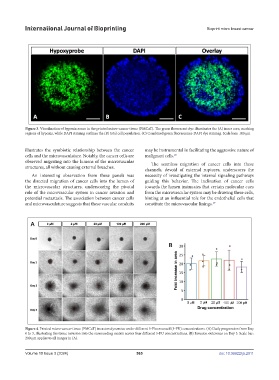
            Figure 3. Visualization of hypoxia zones in the printed micro-cancer tissue (PMCaT). The green fluorescent dye illuminates the (A) inner core, marking
            regions of hypoxia, while DAPI staining outlines the (B) total cell population. (C) Combined green fluorescence-DAPI dye staining. Scale bars: 100 μm


            illustrates the symbiotic relationship between the cancer   may be instrumental in facilitating the aggressive nature of
            cells and the microvasculature. Notably, the cancer cells are   malignant cells. 25
            observed migrating into the lumens of the microvascular   The seamless migration of cancer cells into these
            structures, all without causing external breaches.
                                                               channels, devoid of external ruptures, underscores the
               An  interesting  observation  from  these  panels  was   necessity of investigating the internal signaling pathways
            the directed migration of cancer cells into the lumen of   guiding this behavior. The inclination of cancer cells
            the microvascular structures, underscoring the pivotal   towards the lumen insinuates that certain molecular cues
            role of the microvascular system in cancer invasion and   from the microvascular system may be drawing these cells,
            potential metastasis. The association between cancer cells   hinting at an influential role for the endothelial cells that
            and microvasculature suggests that these vascular conduits   constitute the microvascular linings. 19


            Figure 4. Printed micro-cancer tissue (PMCaT) invasion dynamics under different 5-Fluorouracil (5-FU) concentrations. (A) Daily progression from Day
            0 to 3, illustrating the tissue invasion into the surrounding matrix across four different 5-FU concentrations. (B) Invasion outcomes on Day 3. Scale bar:
            200 μm applies to all images in (A).


            Volume 10 Issue 3 (2024)                       565                                doi: 10.36922/ijb.2911

