


Page 584 - IJB-10-3
P. 584
International Journal of Bioprinting                                 4D printing & simulation for biomedicine


            2.8. Shape-memory effect and experiment            transitions into a glassy state and can maintain its
            for simulation                                     programmed  shape. 24-26   Therefore, DSC  was  used  to
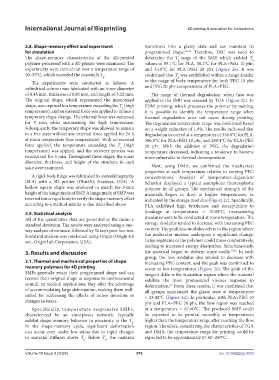
            The shape-memory characteristics of the 4D-printed   determine the  T range of the SMP, which yielded  T
                                                                                                             g
                                                                             g
            polymer processed with a 3D printer were examined. The   values of 59.1°C for PLA, 36.2°C for PLA+PEG 10 phr,
            experiments were carried out over a temperature range of   and 34.0°C for PLA+PEG 20 phr (Figure 2a). It was
            40–55°C, which exceeded the material’s T .         confirmed that T  was established within a range similar
                                             g
                                                                             g
               The experiments were conducted as follows. A    to the range of body temperature for both PEG 10 phr
            cylindrical column was fabricated with an inner diameter   and PEG 20 phr compositions of PLA+PEG.
            of 8.45 mm, thickness of 0.80 mm, and height of 5.22 mm.   The  range  of  thermal  degradation,  when  heat  was
            The original shape, which represented the memorized   applied to the SMP, was assessed by TGA (Figure 2b). In
            shape, was exposed to a temperature exceeding the T  (high   FDM printing, which processes the polymer by melting,
                                                     g
            temperature), and an external force was applied to induce a   it is possible to identify the temperature range when
            temporary shape change. The external force was sustained   thermal degradation does not occur during printing.
            for 5 min while maintaining the high temperature.   The degradation temperature range was confirmed based
            Subsequently, the temporary shape was allowed to remain   on a weight reduction of 1.0%. The results indicated that
            in a free state without any external force applied for 24 h   degradation occurred at a temperature of 336.8°C for PLA,
            at room temperature (low temperature). With no external   306.9°C for PLA+PEG 10 phr, and 289.4°C for PLA+PEG
            force  applied,  the  temperature  exceeding  the  T   (high   20  phr.  With the addition  of  PEG,  the  degradation
                                                    g
            temperature) was applied, and the recovery process was   temperature decreased, indicating a tendency to become
            maintained for 5 min. Throughout these stages, the inner   more vulnerable to thermal decomposition.
            diameter, thickness, and height of the structure in each
            state were examined.                                  Next, using DMA, we confirmed the mechanical
                                                               properties at each temperature relative to varying PEG
               A rigid-body hinge was fabricated by stereolithography   concentrations. Analysis of temperature-dependent
            (SLA) with a 3D printer (Objet30; Stratasys, USA). A   behavior displayed a typical amorphous thermoplastic
            hollow square shape was produced to match the 3-mm   polymer in all groups. The mechanical strength of the
            height of the hinge made of SMP. A hinge made of SMP was   materials began to drop at higher temperatures, as
            inserted into a rigid body to verify the shape-memory effect   indicated by the storage modulus (Figure 2c). Specifically,
            according to a method similar to that described above.  PLA exhibited high brittleness and susceptibility to

            2.9. Statistical analysis                          breakage  at  temperatures  <  10.00°C,  necessitating
            All of the quantitative data are presented as the mean ±   measurements to be conducted at room temperature. The
            standard deviation. The results were analyzed using a one-  storage modulus tended to decrease with increasing PEG
            way analysis of variance, followed by Tukey’s post hoc test.   content. The peak loss modulus refers to the region where
            Statistical analysis was conducted using Origin (Origin 8.6   the molecular motion undergoes a significant change.
            ver., OriginLab Corporation, USA).                 Large segments of the polymer could move cooperatively,
                                                               leading to increased energy dissipation. Simultaneously,
            3. Results and discussion                          the material began to deform more easily. 27,28  In each
                                                               group, the loss modulus also tended to decrease with
            3.1. Thermal and mechanical properties of shape-   increasing PEG content, and the peak was confirmed to
            memory polymers for 4D printing                    occur at low temperatures (Figure 2c). The peak of the
            SMPs generally retain their programmed shape and can   tangent delta is the transition region where the material
            recover their original shape in response to environmental   exhibits  the most  pronounced viscous  response  to
            stimuli. In medical applications, they offer the advantage   deformation.  From these results, it was confirmed that
                                                                         29
            of accommodating large deformation, making them well-  all groups maintained the glassy state at temperatures
            suited for addressing the effects of minor invasions or   < 23.42°C (Figure 2d). In particular, with PLA+PEG 10
            changes in tissue.                                 phr and PLA+PEG 20 phr, the flow region was reached
               Specifically, temperature-responsive SMPs,      at a temperature > 67.60°C. The produced SMP could
            characterized by an amorphous network, typically    be expected to be printed smoothly at temperatures
            exhibit shape-memory behavior in proximity to the T .   higher than the temperature range after reaching the flow
                                                         g
            In  the  shape-memory  cycle,  significant  deformation   region. Therefore, considering the characteristics of TGA
            can occur even under low stress due to rapid changes   and DMA, the temperature range for printing could be
            in material stiffness above  T . Below  T , the material   expected to be approximately 67.60–250°C.
                                     g        g

            Volume 10 Issue 3 (2024)                       576                                doi: 10.36922/ijb.3035

