


Page 588 - IJB-10-3
P. 588
International Journal of Bioprinting                                 4D printing & simulation for biomedicine


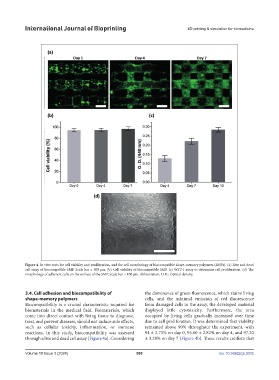
            Figure 4. In vitro tests for cell viability and proliferation, and the cell morphology of biocompatible shape-memory polymers (SMPs). (a) Live and dead
            cell assay of biocompatible SMP. Scale bar = 500 μm. (b) Cell viability of biocompatible SMP. (c) WST-1 assay to determine cell proliferation. (d) The
            morphology of adherent cells on the surface of the SMP. Scale bar = 100 μm. Abbreviation: O.D.: Optical density.


            3.4. Cell adhesion and biocompatibility of         the dominance of green fluorescence, which stains living
            shape-memory polymers                              cells, and the minimal emission of red fluorescence
            Biocompatibility is a crucial characteristic required for   from damaged cells in the assay, the developed material
            biomaterials in the medical field. Biomaterials, which   displayed little cytotoxicity. Furthermore, the area
            come into direct contact with living tissue to diagnose,   occupied by living cells gradually increased over time
            treat, and prevent diseases, should not induce side effects,   due to cell proliferation. It was determined that viability
            such as  cellular  toxicity, inflammation, or  immune   remained above 90% throughout the experiment, with
            reactions. In this study, biocompatibility was assessed   94 ± 2.73% on day 0, 95.00 ± 2.82% on day 4, and 97.20
            through a live and dead cell assay (Figure 4a). Considering   ± 3.28% on day 7 (Figure 4b). These results confirm that


            Volume 10 Issue 3 (2024)                       580                                doi: 10.36922/ijb.3035

