


Page 26 - IJB-4-2
P. 26
The arrival of commercial bioprinters – Towards 3D bioprinting revolution!

                                                               EnvisionTEC 3D-Bioplotters (Figure 5D) can be used in
                                                               sterile biosafety cabinets and feature automated nozzle
                                                               cleaning process, external temperature sensor ports and
                                                                                         [82]
                                                               layer by layer photographic log .
                                                                 GeSiM is a spin-off from a publicly funded German
                                                               research laboratory, Helmholtz-Zentrum Dresden-
                                                               Rossendorf (HZDR). BioScaffolder 3.1 (Figure 5E)
                                                               features a piezoelectric micro-pipetting system, on
                                                               the fourth z-axis allowing non-contact dispensing
                                                               of small drops in the pico- and nanoliter scale [83] .
                                                               Other add-on alternatives on BioScaffolder include
                                                               melt electrospinning and a camera to measure strut
                                                               dimensions.
                                                                nScrypt has a patented Micro Dispense Direct Write
                                                               technology (MDDW)  [84] . nScrypt highlights 3Dn 300
                                                               TE Series (Figure 6D) uses a positive pressure pump,
                                                                         TM
                                                               SmartPump  to achieve resolutions as small as 15
                                                               microns. Along with nTtip™ comes in a wide range of
                                                               standard sizes from 12.5 microns (inner diameter) 125
                                                               microns, the company has demonstrated the possibility
                                                                                                       [85]
                                                               to print living cells with near 100% cell viability .
                                                                Ourobotics’  8 materials with options to incorporate
                                                               additional features such as UV, laser and drill for
                                                               construction of more intricate and challenging
                                                                         [86]
                                                               architectures .
                                                                                            TM
                                                                Pensées designed their Vitarix  Bioprinter (Figure
                                                               4G) to work on a patented articulation-based approach
                                                               instead of Cartesian coordinates [87] .  Pensées has also
                                                               been developing alginate-based bioinks.
                                                                Poietis utilises a technology portfolio from INSERM
                                                               and University of Bordeaux. The company specializes
                                                               in 4D laser-assisted bioprinting technology and has
                                                               collaborations with L'Oréal for developing bioprinting
                                                                                                            [89]
                                                                        [88]
                                                               hair follicle  and BASF for bioprinted skin models .
                                                               Equipped with an eight-axis motion, their NGB 17.03
                                                               (Figure 6C) bioprinting platform is capable of 3D
                                                               printing with a resolution of a single cell [90] . In early
                                                               2018, Poietis has commercially launched the first
                                                                                                    ®
                                                               bioprinted human full skin model Poieskin  fabricated
                                                                                     [91]
                                                               using their NGB bioprinter .
                                                                REGEMAT 3D successfully bioprint osteochondral
                                                               tissue using their REGEMAT 3D V1 (Figure 4E)
                                                               bioprinting system which incorporates three printing
                                                               technologies: Individually Pore Filling (IPF), Injection
                                                                                                            [92]
                                                               Filling (IF) and Fused Deposition Modelling (FDM) .
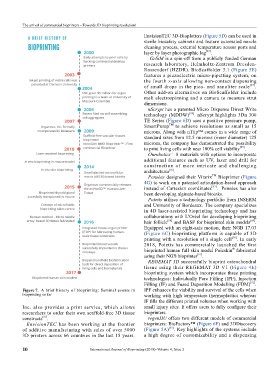
           Figure 7.  A brief history of bioprinting: Seminal events in   IPF enhances the viability and survival of the cells when
           bioprinting so far                                  working with high temperature thermoplastics whereas
                                                               IF fills the different printed volumes when working with
           Inc. also  provides a print service, which allows   small injury sites. It offers users to fully configure their
           researchers to order their own scaffold-free 3D tissue   bioprinters.
                   [81]
           constructs .                                         regenHU offers two different models of commercial
            EnvisionTEC has been working at the frontier       bioprinters: BioFactory™ (Figure 6F) and 3DDiscovery
           of additive manufacturing with sales of over 5000   (Figure 5A) [93] . Key highlights of the systems include
           3D printers across 66 countries in the last 15 years.   a high degree of customizability and a dispensing


           10                          International Journal of Bioprinting (2018)–Volume 4, Issue 2

