


Page 438 - IJB-10-4
P. 438
International Journal of Bioprinting                                 Improving ductility of 3D-printed Zn–Mg


            Table 1. Laser powder bed fusion (LPBF) process parameters   These alloys exhibited relatively low tensile strength (100–
            for printing Zn–Mg samples                         120 MPa) and ductility (0.7–1%). Consequently, nine sets
                                                               of  annealing/heat  treatment  parameters  were  designed,
             Parameters                     Value              involving different holding temperatures and durations at
             Laser power (W)             50, 60, 70, 80, 90    three distinct temperatures (Figure 3b). A vacuum sintering
             Scanning speed (mm/s)   400, 500, 600, 700, 800, 900  furnace (GJC-SJ300, Zhuzhou Guangjichang Technology
             Hatch space (μm)                55                Co., Ltd., China) was employed for annealing after sanding
             Layer thickness (μm)            30                all surfaces of the as-built Zn–Mg alloy samples. Each set
                                                               of annealing processes had a ramp rate of 10℃/min and
                                                               cooling with a furnace.
            was consistent with the phase composition observed in
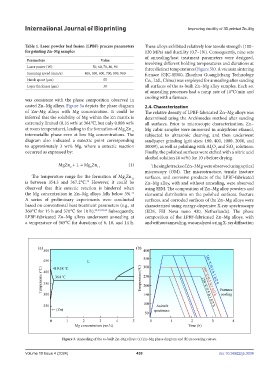
            casted Zn–Mg alloys. Figure 3a depicts the phase diagram   2.4. Characterization
            of  Zn–Mg  alloys  with  Mg  concentration.  It  could  be   The relative density of LPBF-fabricated Zn–Mg alloys was
            inferred that the solubility of Mg within the Zn matrix is   determined using the Archimedes method after sanding
            extremely limited (0.16 wt% at 364℃, but only 0.008 wt%   all surfaces. Prior to microscopic characterization, Zn–
            at room temperature), leading to the formation of Mg Zn    Mg cubic samples were immersed in anhydrous ethanol,
                                                         11
                                                      2
            intermetallic  phase  even  at  low  Mg  concentrations.  The   subjected to ultrasonic cleaning, and then underwent
            diagram also indicated a eutectic point corresponding   sandpaper grinding (grit sizes: 180, 400, 1000, 2000, and
            to approximately 3 wt% Mg, where a eutectic reaction   3000#), as well as polishing with Al O  and SiO  solutions.
                                                                                             3
                                                                                                     2
                                                                                           2
            occurred as expressed by:                          Finally, the polished surfaces were etched with a nitric acid
                                                               alcohol solution (4 wt%) for 10 s before drying.
                          MgZn  + L → Mg Zn             (1)       The single tracks of Zn–3Mg were observed using optical
                               2        2  11
                                                               microscopy  (OM).  The  microstructure,  tensile  fracture
               The temperature range for the formation of Mg Zn    surfaces, and corrosive products of the LPBF-fabricated
                                                      2
                                                         11
                                      29
            is between 354.3 and 367.2℃.  However, it could be   Zn–Mg alloy, with and without annealing, were observed
            observed that this eutectic reaction is hindered when   using SEM. The composition of Zn–Mg alloy powders and
            the Mg concentration in Zn–Mg alloys falls below 3%.    elemental distribution on  the polished surfaces,  fracture
                                                         31
            A series of preliminary experiments were conducted   surfaces, and corroded surfaces of the Zn–Mg alloys were
            based on conventional heat treatment parameters (e.g., at   characterized using energy-dispersive X-ray spectroscopy
            360℃ for 15 h and 370℃ for 10 h). 28,29,32,33  Subsequently,   (EDS, FEI Nova nano 430, Netherlands). The phase
            LPBF-fabricated Zn–Mg alloys underwent annealing at   composition of  the  LPBF-fabricated Zn–Mg  alloys,  with
            a temperature of 365℃ for durations of 6, 10, and 14 h.   and without annealing, was analyzed using X-ray diffraction


                            Figure 3. Annealing of the as-built Zn–Mg alloys: (a) Zn–Mg phase diagram and (b) processing curves.


            Volume 10 Issue 4 (2024)                       430                                doi: 10.36922/ijb.3034

