


Page 73 - IJB-10-4
P. 73
International Journal of Bioprinting                          Unique characteristics of 3D-printed microneedles


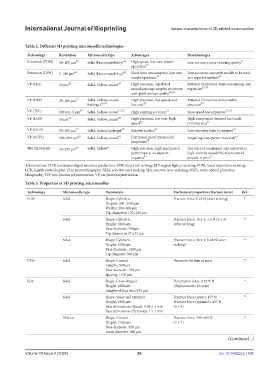
            Table 2. Different 3D printing microneedle technologies
             Technology   Resolution  Microneedle type   Advantages              Disadvantages
             Extrusion (FDM)  50–200 μm 45  Solid (biocompatibility) 46  High speed, low cost, simple   Low accuracy, poor printing quality 47
                                                         operation 45
             Extrusion (DIW)  1–250 μm 48  Solid (biocompatibility) 49  Short time consumption, low cost,   Low accuracy, currently unable to be used
                                                         simple operation 48     as a separate method 49
             VP (SLA)     10 μm 45    Solid, hollow, coated 10  High precision, capable of   Material limitations, time-consuming, and
                                                         manufacturing complex structures  expensive 45,47
                                                         with good surface quality 45,47
             VP (DLP)     25–100 μm 47  Solid, hollow, coated,   High precision, fast speed, and   Material limitations and unstable
                                      hydrogel 10,50     low cost 47             structure 47
             VP (TPP)     100 nm–5 μm 47  Solid, hollow, coated 51,52  High printing accuracy 53  Slow speed and expensive 54,55
             VP (LCD)     50 μm 56    Solid, hollow, coated 56  High precision, low cost, high   High component demand and small
                                                         speed 56                printing area 57
             VP (CLIP)    50–100 μm 10  Solid, coated, hydrogel 10  Smooth surface 58  Low-viscosity resin is required 59
             VP (SOPL)    100–300 μm 60  Solid, hollow, coated 61  Fast speed, good mechanical   Requiring transparent materials 61
                                                         properties 60
             PBF (SLS/SLM)  50–250 μm 47  Solid, hollow 62  High precision, high mechanical   The price of equipment and materials is
                                                         performance, no support   high, and the reusability of unsintered
                                                         required 47             powder is poor 9
            Abbreviations: CLIP, continuous liquid interface production; DIW, direct ink writing; DLP, digital light processing; FDM, fused deposition molding;
            LCD, liquid crystal display; SLA, stereolithography; SLM, selective laser melting; SLS, selective laser sintering; SOPL, static optical projection
            lithography; TPP, two-photon polymerization; VP, vat photopolymerization.
            Table 3. Properties of 3D printing microneedles
             Technology     Microneedle type  Parameters                   Mechanical properties (fracture force)  Ref.
             FDM            Solid             Shape: Cylindric             Fracture force: 0.23 N (after etching)  49
                                              Heights: 200–2500 μm
                                              Widths: 400–600 μm
                                              Tip diameters: 170–220 μm
                            Solid             Shape: Cylindric             Fracture force: 10.5  ±  1.3 N (3 × 3)   64
                                              Height: 1000 μm              (after etching)
                                              Base diameter: 700 µm
                                              Tip diameters: 97 ± 21 μm
                            Solid             Shape: Cylindric             Fracture force: 36.0  ±  0.48 N (after   63
                                              Height: 1500 µm              etching)
                                              Base diameter: 1000 µm
                                              Tip diameter: 500 µm
             DIW            Solid             Shape: Conical               Penetrate the skin of mice    65
                                              Lengths: 800 μm
                                              Base diameter: 700 μm
                                              Spacing: 1100 μm
             SLA            Solid             Shape: Cross-shaped          Penetration force: 2.2545 N   75
                                              Height: 1000 µm              (displacement: 1.8 mm)
                                              Lengths of four fins: 430 µm
                            Solid             Shape: Spear and pyramid     Fracture force (spear): 175 N  78
                                              Height: 1000 μm              Fracture force (pyramid): 457 N
                                              Base dimensions (Spear): 0.08 × 1 mm  (6 × 8)
                                              Base dimensions (Pyramid): 1 × 1 mm
                            Hollow            Shape: Conical               Fracture force: 350–400 N     67
                                              Height: 1150 μm              (7 × 7)
                                              Base diameter: 950 μm
                                              Inner diameter: 560 μm
                                                                                                  (Continued...)


            Volume 10 Issue 4 (2024)                        65                                doi: 10.36922/ijb.1896

