


Page 60 - IJB-5-1
P. 60
Mechanisms and modeling of electrohydrodynamic phenomena
2
parameters are given . According to data obtained hydrodynamic time is t = lD n . The characteristic flow
[18]
from experiments, Cloupeau and Prunet found that the γε ε h Q V
cone-jet mode only appears at a certain range of voltage rate is Q = ρ 0 r , characteristic distance 05 . and
0
and flow rate, and instabilities including skewed and K ε 0 05. . γ D
0
multiple-jet regime appear in a larger electric field . At characteristic current I = γ ( ρ ) ε 0
[57]
0
specific conditions, operating diagram of cone-jet can These dimensionless groups have a certain influence
be described as changes of flow rate and electric field on jet diameter and current, qualitatively. In the classical
strength [5,57] . Domains of cone-jet may become different EHD jetting system, the charge relaxation time is smaller
by small changes in the selection of parameters mentioned than the hydrodynamic time (t <t ); most of EHD
above (such as working fluid, setup of the experiment, printing, electrospray, and electrospinning belong to
h
e
and geometry of nozzle). Furthermore, experimental this category . Charges are induced toward the surface
[33]
measurements are also difficult for the flow fields in a of the liquid to form a thin layer of charge under the
free jet whose diameter is often on the verge of optical liquid-gas interface , and both the shape of the liquid
[33]
resolution . cone and the jet stability are affected by the amount of
[5]
[38]
3.2.1 Dimensional Analysis electric charge on the liquid surface . For liquids with
relatively high conductivities (above 10 S/m), the
−4
In this section, the effect of parameters on the transition electrical relaxation time is short and sufficient charge
process is reviewed. The cone-jet transition is confined to can accumulate on the surface to counteract the surface
the region near the conical apex. First, the dimensional tension force . The jet formation zone is limited to the
[38]
analysis is used to give a qualitative description of the jet apex of the conical meniscus . The remaining surface is
[57]
diameter, D , and emitted current, I j [38] . The jet diameter and practically equipotential, and an almost static equilibrium
j
current are related to the operating parameters (flow rate of forces exists at each point . The shape of the cone
[57]
Q and electric field strength E), liquid material properties may have a practically straight generatrix with a very fine
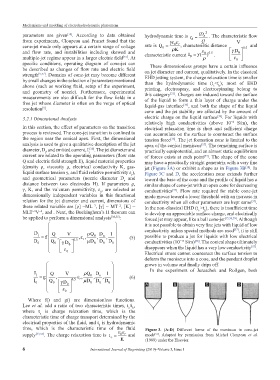
(density ρ, viscosity μ, electrical conductivity K, gas- jet (Figure 3A) or exhibit a shape as in Figure 3B . In
[18]
liquid surface tension γ, and fluid relative permittivity ε ), Figure 3C and D, the acceleration zone extends further
r
and geometrical parameters (nozzle diameter D and toward the base of the cone and the profile of liquid has a
n
distance between two electrodes H). If parameters ρ, similar shape of cone-jet with an open cone for decreasing
γ, K, and the va`cuum permittivity, ε , are selected as conductivities . Flow rate required for stable cone-jet
[57]
0
dimensionally independent variables in this functional mode moves toward a lower threshold with an increase in
relation for the jet diameter and current, dimensions of conductivity when all other parameters are kept same .
[57]
these related variable are [ρ] =ML , [γ] = MT , [K] = In the non-classical EHD (t >t ), there is insufficient time
−3
−2
e
h
MLT V , and . Next, the Buckingham’s Π theorem can to develop an appreciable surface charge, and electrically
−3
−2
be applied to perform a dimensional analysis [38,55] : forced jet may appear, like a ball cone-jet [33,58,59] . Although
it is not possible to obtain very fine jets with liquid of low
conductivity unless special methods are used , it is still
[57]
D Q V ρ Q D l
j = f , , , 0 , n , (5) possible to produce a jet for liquids with low electrical
ε
D 0 Q 0 γ D 05 . r µ D 0 D 0 D 0 conductivities (10 S/m) . The conical shape ultimately
−13
[58]
0
[57]
ε 0 disappears when the liquid has a very low conductivity .
Electrical stress cannot counteract the surface tension to
deform the meniscus into a cone, and the pendant droplet
grows in volume and finally drips off.
In the experiment of Juraschek and Rollgen, both
I ρ Q D l
j = g Q , V ε , 0 , n , (6)
I 0 Q 0 γ D 05 . r µ D 0 D 0 D 0 A C
0
ε 0 B D
Where f() and g() are dimensionless functions.
Lee et al. add a ratio of two characteristic times, t /t ,
e h
where t is charge relaxation time, which is the
e
characteristic time of charge transport determined by the
electrical properties of the fluid, and t is hydrodynamic
h
time, which is the characteristic time of the fluid Figure 3. (A-D) Different forms of the meniscus in cone-jet
supply [33,55] . The charge relaxation time is t = r and mode . Adapted by permission from Michel Cloupeau et al.
[57]
0
e
K (1989) under the Elsevier.
6 International Journal of Bioprinting (2019)–Volume 5, Issue 1

