


Page 58 - IJB-10-5
P. 58
International Journal of Bioprinting                                  Medical regenerative in situ bioprinting


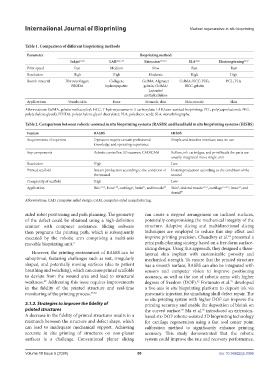
            Table 1. Comparison of different bioprinting methods
             Parameter                                       Bioprinting method
                               Inkjet 37,48     LAB 40,41,49   Extrusion 29,50,51  SLA 44,45  Electrospinning 46,47
             Print speed         Fast           Medium            Slow             Fast            Fast
             Resolution         High             High           Moderate          High             High
             Bioink material  Fibrin/collagen;   Collagen;    GelMA; Alginate/  GelMA; HCC-PEG;   PCL; PLA
                               PEGDA          hydroxyapatite  gelatin; GelMA/   HCC-gelatin
                                                                Laponite/
                                                              methylcellulose
             Applications     Vessels; skin      Bone          Stomach; skin    Skin; muscle       Skin
            Abbreviations: GelMA, gelatin methacryloyl; HCC, 7-hydroxycoumarin-3-carboxylate; LAB, laser-assisted bioprinting; PCL, poly(caprolactone); PEG,
            poly(ethylene glycol); PEGDA, poly(ethylene glycol diacrylate); PLA, poly(lactic acid); SLA, stereolithography.
            Table 2. Comparison between robotic-assisted in situ bioprinting systems (RASBS) and handheld in situ bioprinting systems (HISBS)

             Feature                     RASBS                            HISBS
             Requirements of expertise   Operators require certain professional   Simple and intuitive interface; easy-to-use
                                         knowledge and operating experience
             Key components              Robotic controller; 3D scanner; CAD/CAM  Rollers, ink cartridges, and print heads the parts are
                                                                          usually integrated into a single unit
             Resolution                  High                             Low
             Printed scaffold            Instant production according to the condition of   Instant production according to the condition of the
                                         the wound                        wound
             Complexity of scaffold      High                             Low
                                                              45
                                                                             9
                                                                                                       58
                                                          1
             Application                 Skin 37,52 , bone , cartilage , brain , and muscle 44  Skin , skeletal muscle 53,54 , cartilage 55,56,57 , bone , and
                                                  1,40
                                                                          dental 59
            Abbreviations: CAD, computer-aided design; CAM, computer-aided manufacturing.
            aided robot positioning and path planning. The geometry   can create a stepped arrangement on inclined surfaces,
            of  the  defect  could  be  obtained  using  a high-definition   potentially compromising the mechanical integrity of the
            scanner with computer assistance. Slicing software   structure.  Adaptive  slicing  and  multidirectional  slicing
            then programs the printing path, which is subsequently   techniques are employed to reduce this step effect and
                                                                                                  62
            executed by the robotic arm comprising a multi-axis   improve printing precision. Chaudhry et al.  presented a
            movable bioprinting unit. 2                        print path-planning strategy based on a free-form surface-
                                                               slicing design. Using this approach, they designed a three-
               However, the printing environment of RASBS can be   layered skin implant with customizable porosity and
            suboptimal, featuring challenges such as wet, irregularly   mechanical strength. To ensure that the printed structure
            shaped, and potentially moving surfaces (due to patient   has a smooth surface, RASBS can also be integrated with
            breathing and twitching), which can cause printed scaffolds   sensors and computer vision to improve positioning
            to deviate from the wound area and lead to structural   accuracy, as well as the use of robotic arms with higher
            weakness.  Addressing this issue requires improvements   degrees of freedom (DOF).  Fortunato et al.  developed
                                                                                     62
                                                                                                   71
                    28
            in the fidelity of the printed structure and real-time   a five-axis in situ bioprinting platform to deposit ink via
            monitoring of the printing process. 35,50          pneumatic injection for simulating skull defect repair. The
                                                               in situ printing system with higher DOF can improve the
            2.1.2. Strategies to improve the fidelity of       printing accuracy and enable the deposition of bioink on
            printed structures                                 the curved surface.  Ma et al.  introduced an extrusion-
                                                                              68
                                                                                       66
            A decrease in the fidelity of printed structures results in a   based six-DOF robotic-assisted 3D bioprinting technology
            mismatch between the structure and defect shape, which   for cartilage regeneration using a fast tool center point
            can lead to inadequate mechanical support. Achieving   calibration  method  to  significantly  enhance  printing
            accurate  in situ  printing of structures on non-planar   accuracy. This study demonstrated that the robotic
            surfaces is a challenge. Conventional planar slicing   system could improve the rate and recovery performance.


            Volume 10 Issue 5 (2024)                        50                                doi: 10.36922/ijb.3366

