


Page 125 - IJB-10-6
P. 125
International Journal of Bioprinting                                 Fluid mechanics of extrusion bioprinting


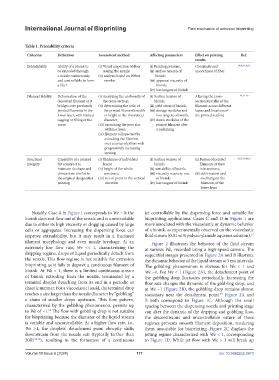
            Table 1. Printability criteria
             Criterion    Definition       Assessment method     Affecting parameters  Effect on printing   Ref.
                                                                                    results
             Extrudability  Ability of a bioink to   (i)  Visual inspection of fiber   (i)  Printing pressure;   Continuity and   38,40,41,42,43
                          be extruded through   issuing the nozzle;   (ii)  surface tension of   smoothness of fiber
                          a nozzle continuously   (ii)  analysis based on Weber   bioink;
                          and controllably to form   number      (iii)  apparent viscosity of
                          a fiber                                   bioink;
                                                                 (iv) loss tangent of bioink
             Filament fidelity  Deformation of the   (i)  Analyzing the uniformity of   (i)  Surface tension of   Altering the cross-  44, 45–49
                          deposited filament as it   the cross-section;   bioink;   sectional profile of the
                          bridges over previously   (ii)  determining the ratio of   (ii) yield stress of bioink;   filament across different
                          printed filaments in the   the printed filament’s width   (iii)  storage modulus and   layers and locations of
                          lower layer, with limited   or height to the theoretical   loss tangent of bioink;   the printed scaffold
                          sagging or filling of the   diameter;   (iv)  elastic modulus of the
                          pores            (iii)  examining the pore size   printed filament after
                                              within a layer;       crosslinking
                                           (iv)  filament collapse test by
                                              extruding the filament
                                              over a series of pillars with
                                              progressively increasing
                                              spacing
             Structural   Capability of a printed   (i)  Thickness of individual   (i)  Surface tension of   (i)  Fusion of printed   36,38, 50,44,51
             integrity    3D construct to    layers;               bioink;            filaments at their
                          maintain its shape and   (ii)  height of the whole   (ii)  wettability of bioink;   intersections;
                          dimensions similar to   construct;     (iii)  viscosity recovery rate   (ii)  deformation and
                          the original design after   (iii)  size of pores in the vertical   of bioink;   overhang on the
                          printing            direction          (iv)  loss tangent of bioink  filaments of the
                                                                                       lower layer


               Notably, Case A in Figure 1 corresponds to We = 0; the   jet controllable by the dispensing force and suitable for
            bioink does not flow out of the nozzle and is unextrudable   bioprinting applications. Cases C and D in  Figure  1 are
            due to either its high viscosity or clogging caused by large   more associated with the viscoelastic or dynamic behavior
            cells or aggregates. Increasing the dispensing force can   of a bioink, as experimentally observed on the viscoelastic
            improve extrudability, but it may result in a fractured   fluid stream (0.01 wt% polyacrylamide aqueous solution). 52
            filament morphology and even nozzle breakage. At an   Figure  2 illustrates the behavior of the fluid stream
            extremely low flow rate,  We  << 1, characterizing the   at various We, recorded using a high-speed camera. The
            dripping regime, drops of liquid periodically detach from   sequential images presented in Figure 2A and B illustrate
            the nozzle. This flow regime is not suitable for extrusion   the dynamic behavior of the liquid stream at 5 ms intervals.
            bioprinting as it fails to deposit a continuous filament of   The gobbling phenomenon is obvious for  We < 1 and
            bioink. At  We < 1, there is a limited continuous stream   We ~1. For We < 1 (Figure 2A), the detachment point of
            of bioink extruding from the nozzle, terminated by a   the gobbling drop fluctuates periodically. Increasing the
            terminal droplet detaching from its end in a periodic or   flow rate changes the dynamic of the gobbling drop, and
            chaotic manner. For a viscoelastic liquid, the terminal drop   at We ~1 (Figure 2B), the gobbling drop remains almost
            reaches a size larger than the nozzle diameter by “gobbling”   stationary near the detachment point.   Figure  2A  and
                                                                                               55
            a  chain  of smaller  drops  upstream.  This flow  pattern,   B both correspond to  Figure  1C. Although the small
            characterized by the gobbling phenomenon, persists up   spacing between the dispensing nozzle and printing stage
                      55
            to We of ~1.  The flow with gobbling drop is not suitable   can alter the dynamic of the dripping and gobbling flow,
            for bioprinting because the diameter of the liquid stream   the discontinuous and uncontrollable nature of these
            is variable and uncontrollable. At a higher flow rate, i.e.,   regimes prevents smooth filament deposition, rendering
            We >1, the droplets’ detachment point abruptly shifts   them  unsuitable  for  bioprinting.  Figure  2C  displays  the
            downstream from the nozzle exit (typically farther than   jetting regime characterized with We < 1, corresponding
            20Ri  52,53 ), resulting in the formation of a continuous   to Figure 1D. While jet flow with We > 1 will break up

            Volume 10 Issue 6 (2024)                       117                                doi: 10.36922/ijb.3973

