


Page 28 - IJB-8-4
P. 28
Xie, et al.
            A


            B                                                D


                                                             E


            C                                               F


           G                       H                       I                       J


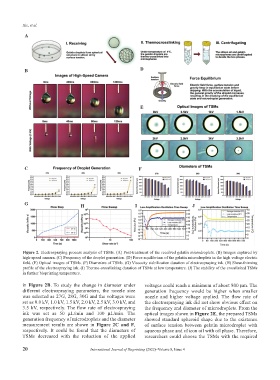
           Figure 2. Electrospraying process analysis of TSMs. (A) Post-treatment of the received gelatin microdroplets. (B) Images captured by
           high-speed camera. (C) Frequency of the droplet generation. (D) Force equilibrium of the gelatin microdroplets in the high voltage electric
           field. (E) Optical images of TSMs. (F) Diameters of TSMs. (G) Viscosity stabilization duration of electrospraying ink. (H) Shear-thinning
           profile of the electrospraying ink. (I) Thermo-crosslinking duration of TSMs at low temperature. (J) The stability of the crosslinked TSMs
           in further bioprinting temperature.

           in Figure 2B. To study the change in diameter under   voltages could reach a minimum of about 800 μm. The
           different  electrospraying  parameters,  the  nozzle  size   generation  frequency  would  be  higher  when  smaller
           was selected as 27G, 28G, 30G and the voltages were   nozzle  and  higher  voltage  applied.  The  flow  rate  of
           set as 0.0 kV, 1.0 kV, 1.5 kV, 2.0 kV, 2.5 kV, 3.0 kV, and   the electrospraying ink did not show obvious effect on
           3.5 kV, respectively. The flow rate of electrospraying   the frequency and diameter of microdroplets. From the
           ink  was  set  as  50  μL/min  and  100  μL/min.  The   optical images shown in Figure 2E, the prepared TSMs
           generation frequency of microdroplets and the diameter   showed  standard  spheroid  shape  due  to  the  existence
           measurement results are shown in Figure 2C and F,   of  surface  tension  between  gelatin  microdroplet  with
           respectively.  It  could  be  found  that  the  diameters  of   aqueous phase and silicon oil with oil phase. Therefore,
           TSMs  decreased  with  the  reduction  of  the  applied   researchers could choose the TSMs with the required


           20                          International Journal of Bioprinting (2022)–Volume 8, Issue 4

