


Page 30 - IJB-8-4
P. 30
Xie, et al.
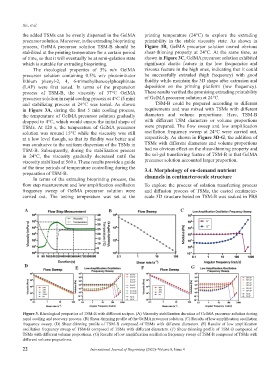
           the added TSMs can be evenly dispersed in the GelMA   printing  temperature  (24°C)  to  explore  the  extruding
           precursor solution. Moreover, in the extruding bioprinting   printability  in  the  stable  viscosity  state.  As  shown  in
           process,  GelMA  precursor  solution  TSM-B  should  be   Figure  3B,  GelMA  precursor  solution  owned  obvious
           stabilized at the printing temperature for a certain period   shear-thinning  property  at  24°C. At  the  same  time,  as
           of time, so that it will eventually be at semi-gelation state   shown in Figure 3C, GelMA precursor solution exhibited
           which is suitable for extruding bioprinting.        significant  elastic  feature  in  the  low  frequencies  and
               The  rheological  properties  of  5%  w/v  GelMA   viscous feature in the high ones, indicating that it could
           precursor  solution  containing  0.5%  w/v  photoinitiator   be  successfully  extruded  (high  frequency)  with  good
           lithium  phenyl-2,  4,  6-trimethylbenzoylphosphinate   fluidity while maintain the 3D shape after extrusion and
           (LAP)  were  first  tested.  In  terms  of  the  preparation   deposition  on  the  printing  platform  (low  frequency).
           process  of  TSM-B,  the  viscosity  of  37°C  GelMA   These results verified the promising extruding printability
           precursor solution in rapid cooling process at 4°C (5 min)   of GelMA precursor solution at 24°C.
           and  stabilizing  process  at  24°C  was  tested. As  shown   TSM-B  could  be  prepared  according  to  different
           in  Figure  3A,  during  the  first  5  min  cooling  process,   requirements and was mixed with TSMs with different
           the temperature of GelMA precursor solution gradually   diameters  and  volume  proportions.  Here,  TSM-B
           dropped to 4°C, which would ensure the initial shape of   with  different  TSM  diameters  or  volume  proportions
           TSMs. At  120  s,  the  temperature  of  GelMA  precursor   were  prepared.  The  flow  sweep  and  low  amplification
           solution was around 15°C while the viscosity was still   oscillation  frequency  sweep  at  24°C  were  carried  out,
           at a low level though, so that its fluidity was better and   respectively. As shown in Figure 3D-G, the addition of
           was conducive to the uniform dispersion of the TSMs in   TSMs with different diameters and volume proportions
           TSM-B.  Subsequently,  during  the  stabilization  process   had no obvious effect on the shear-thinning property and
           in  24°C,  the  viscosity  gradually  decreased  until  the   the sol-gel transferring feature of TSM-B in that GelMA
           viscosity stabilized at 560 s. These results provide a guide   precursor solution accounted larger proportion.
           of the time periods of temperature controlling during the   3.4. Morphology of on-demand nutrient
           preparation of TSM-B.                               channels in centimeter-scale structure
               In  terms  of  the  extruding  bioprinting process,  the
           flow step measurement and low amplification oscillation   To  explore  the  process  of  solation  transferring  process
           frequency  sweep  of  GelMA  precursor  solution  were   and  diffusion  process  of  TSMs,  the  casted  centimeter-
           carried  out.  The  testing  temperature  was  set  at  the   scale 3D structure based on TSM-B was soaked in PBS


            A                                  B                              C


           D                     E                           F                    G


           Figure 3. Rheological properties of TSM-B with different recipes. (A) Viscosity stabilization duration of GelMA precursor solution during
           rapid cooling and recovery process. (B) Shear-thinning profile of the GelMA precursor solution. (C) Results of low amplification oscillation
           frequency sweep. (D) Shear-thinning profile of TSM-B composed of TSMs with different diameters. (E) Results of low amplification
           oscillation frequency sweep of TSM-B composed of TSMs with different diameters. (F) Shear-thinning profile of TSM-B composed of
           TSMs with different volume proportions. (G) Results of low amplification oscillation frequency sweep of TSM-B composed of TSMs with
           different volume proportions.

           22                          International Journal of Bioprinting (2022)–Volume 8, Issue 4

