


Page 466 - IJB-9-2
P. 466
International Journal of Bioprinting                                            Bioprinting of exosomes


               In a different approach, engineered gene-activated
            EXOs were grafted onto acellular 3D-printed porous      Ref.  [74]    [75]      [76]   [77]
            polycaprolactone (PCL)-based  scaffolds for  vascularized
            bone  remodeling  in  vivo .  More  specifically,  the  gene
                                 [76]
            encoded for VEGF protein was exogenously loaded into
            EXOs  derived  from  chondrogenic  progenitor  cell  line    Skeletal myogenesis  Cartilage repair and   Segmental bone   Bone tissue regen-
            ATDC5 and anchored onto the surface of PCL scaffolds    Potential     application  regeneration
            fabricated via extrusion-based bioprinting through a flexible                      defects  eration
            linker  to  confer  dual  functions:  induction  of  osteogenic
            differentiation and promotion of vascularization in vivo.
            Surface modification was carried out on the 3D-printed
            PCL scaffolds using 10% 1,6-hexanediamine solution to                   Rabbit osteo-  chondral defect   Rat radial defect
            yield amino group-coated scaffolds, to which an exosomal   Model  In vitro  In vivo   model   In vivo   model  In vitro
            anchor peptide, CP05, was covalently tethered via EDC/
            NHS    (1-(3-dimethylaminopropyl)-3-ethylcarbonamide
            hydrochloride/n-hydroxysuccinimide) chemistry with a
            graft efficiency of approximately 27%. Finally, the CP05-
            modified PCL scaffolds were incubated with EXOs carrying
            the VEGF plasmid DNA to engineer EXO-activated PCL           M1 EXOs: spatial inhibition of   M2 EXOs: spatial promotion of   Restore chondrocyte mito-  Enhance chondrocyte migra- tion Promote M2 macrophage   Induce cell binding, prolifera- tion, and differentiation of cells
            bone scaffolds. Micro-computed tomography data showed   Exosome function  chondrial dysfunction   Increase osteogenesis and   Promote osteoinductivity
            that the EXO-activated PCL scaffolds demonstrated              myogenesis  myogenesis  polarization  angiogenesis
            evidence of newly-formed bone that had integrated well
            with the native bone tissue 12 weeks after implantation
            in a rat radial defect model. Additionally, hematoxylin
            and eosin staining confirmed the presence of newly-
            formed blood vessels, while immunofluorescence staining               Homogenous bulk   Surface adsorption  Homogenous bulk
            demonstrated a positive staining for the angiogenic marker   Exosome    presentation  Spatial distribu-  distribution  Surface grafting   via covalent   distribution Abbreviations: AdMSC, adipose-derived mesenchymal stem cells; Alg, alginate; BMMSC, bone marrow-derived mesenchymal stem cell; ECM, extracellular matrix; EXO, exosome; M1 EXOs, exo-
            CD31. These findings suggest that there is potential use of    tion                  linkages
            functional-engineered EXOs tethered to well-designed
            acellular scaffolds in the treatment of segmental bone
            defects.                                                                                         somes derived from M1 macrophage phenotype; M2 EXOs, exosomes derived from M2 macrophage phenotype; MSC, mesenchymal stem cells; PCL, polycaprolactone.

               In  a different  strategy, lyosecretome, a  freeze-dried   Bioprinting tech-  Stereolithography  Melt/pneumatic
            formulation of MSC secretome that is known to contain                            Melt extrusion  Melt extrusion  extrusion
            EXOs and secreted proteins, directly adsorbed onto the    nique  Inkjet
            surfaces of 3D-printed PCL scaffolds or incorporated in an
            Alg bioink and co-printed along with PCL was evaluated as
            a potential scaffold prototype for bone tissue engineering .  Table 2. List of studies combining bioprinting with EXOs for potential tissue regenerative applications
                                                        [77]
            In this study, AdMSCs harvested from the adipose tissues              Gelatin methacry-  late/decellularized   porcine cartilage
            of humans were employed, and a cryoprotectant, mannitol,   composition  mentioned
            was added to the conditioned media prior to the freeze-  Bioink    Not      ECM  PCL    PCL  PCL/Alg
            drying process to preserve the integrity of EXO and stabilize
            the secreted proteins. A rapid release of EXOs and proteins
            was observed from PCL scaffolds employing the adsorption
            approach, while a controlled release of EXOs and proteins   Exogenous            Gene encoded
            was observed in composite scaffolds composed of PCL and   cargo                    for VEGF
            alginate hydrogel. In addition, the release of these bioactive   -    -                 -
            factors can be fine-tuned by altering the composition and
            crosslinking density of the Alg hydrogel.
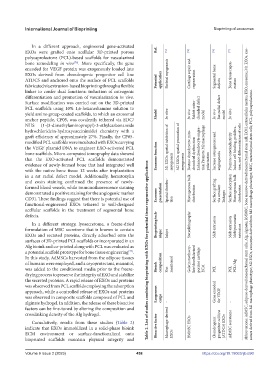
               Cumulatively, results from these studies (Table 2)        Macrophage-derived    progenitor cell line   AdMSC secretome
            indicate that EXOs immobilized in a solid-phase bioink   Bioactive factor  BMMSC EXOs  Chondrogenic   (ATDC5) EXOs
            ECM environment or surface-functionalized onto                 EXOs
            bioprinted scaffolds maintain physical integrity and


            Volume 9 Issue 2 (2023)                        458                          https://doi.org/10.18063/ijb.690

