


Page 350 - IJB-9-5
P. 350
International Journal of Bioprinting                            3D printing of tough and self-healing hydrogels


            ~15 kPa. It also had self-healing properties, being able to   (Anton Paar GmbH, Austria), with a parallel plate
            recover from a break within 5 min. Carbon nanotubes   geometry, equipped with a 25-mm plate with a distance of
            (CNTs) were incorporated into the PVA/TA/PAA hydrogel   ~1 mm. The shear storage modulus (G′) and loss modulus
            ink as nanofillers to improve its electrical conductivity, and   (G″) were measured with temperature scans ranging from
            the applicability of the PVA/TA/PAA/CNT hydrogel ink   25°C to 95°C at a constant shear strain of 1% and frequency
            was confirmed through in vitro biocompatibility and tissue   of 10 radian/s. The shear viscosity of the hydrogel was
            adhesiveness with the chemical functionalization of the   measured in steady-state flow at a logarithmic sweep of
            hydrogel chain. Also, light-emitting diode (LED) lighting   shear rates from 0.1 s  to 100 s  to investigate the shear-
                                                                                -1
                                                                                        -1
            tests and resistance change via a printed circuit with PVA/  thinning behavior at 85°C.
            TA/PAA/CNT hydrogel ink showed the possibility of a
            strain sensor.                                     2.4. 3D printing of hydrogel ink
                                                               All printing was performed using an EZROBO-5GX 3D
            2. Materials and methods                           printer  with an  AD3300C  dispenser  (Iwashita,  Japan),

            2.1. Preparation of PVA/TA/PAA hydrogel ink        equipped with a nozzle and temperature controller. During
            To prepare hydrogel ink, the 4000 mg of PVA (Sigma-  printing, ink was heated to 85°C using a temperature
            Aldrich, St. Louis, MO, USA, 20% w/w, Mw 89,000–   control system and syringe heating pad, and various
            98,000) powder was added to deionized (DI) water, heated   nozzle sizes (600-, 400-, 200-, and 100-μm size of nozzles)
            at 90°C, and continuously stirred to obtain a transparent   were used. Printing structures were designed using Ez-
            solution. After 20 min, TA (Sigma-Aldrich, St. Louis, MO,   EDITOR robot communication software. The diameters
            USA) at different ratios (PVA: TA = 1:0.5, 1:1, and 1:2) was   of the printed hydrogels were compared with those of the
            added to the PVA solution and stirred for 2 h to obtain a   printing nozzle using a field-emission scanning electron
            homogeneous PVA/TA solution. The PVA/TA solution was   microscope (FE-SEM, JSM-IT-500HR, JEOL, Japan) at
            then poured into a mold, pressed to be spread thinly and   an accelerating voltage of 15.0 kV with gold sputtering to
            widely, stored in a refrigerator at -20°C for 8 h, and thawed   enhance image contrasts.
            at 25°C for 4 h to form a PVA/TA hydrogel. The PVA/TA   2.5. Mechanical characterization of hydrogel ink
            hydrogel was dried in an oven at 37°C for 1 h and annealed   The mechanical properties of the hydrogels were
            at 100°C for 1 h to obtain a dry PVA/TA film. To form   characterized using a tensile testing machine (MultiTest
            the PVA/TA/PAA network, PVA/TA film was immersed   2.5-DV, Mecmesin, UK) with a 50 N load cell at a speed
            in 45  mL of aqueous acrylic acid solution (30%  w/w   of 50 mm/min to determine their ultimate tensile strength
            acrylic  acid,  0.03%  w/w  N,  N′-bis(acryloyl)cystamine,   and elongation at break. The bulk hydrogel ink samples
            and 0.15% w/w 2,2′-azobis(2-methylpropionamidine)   were cut to a size of 200 mm (height) × 100 mm (width).
            dihydrochloride in deionized water) for 2 h. The soaked   The printed hydrogel ink samples of 200 mm (height) ×
            hydrogel was heated at 70°C for 30 min to form the PAA   100 mm (width) were manufactured using the above-
            network. To prepare the pure PVA hydrogel and PVA/  mentioned EZROBO-5GX 3D printer with a nozzle size
            PAA hydrogel, we used a PVA hydrogel without TA but   of 600 μm. For the tensile tests, at least three samples of
            otherwise followed the same process.
                                                               each type were tested and averaged to determine their
            2.2. Preparation of PVA/TA/PAA/CNT hydrogel ink    properties.
            The COOH functionalized CNT powder (Nano-lab, USA,
            outer diameter of 30 ± 15 nm, length of 1–5 μm) was   2.6. Swelling ratio measurement
            dispersed in 10 mL of DI water to concentrations of 1, 3,   The hydrogels were soaked in DI water at room temperature
            6, and 9 mg/mL. Each solution was sonicated at 450 rpm   to determine their swelling ratio. All hydrogel samples
            for 2 h using a tip sonicator (Qsonica LLC, Newtown, CT,   were prepared with similar weights and the same pattern.
            USA) to obtain a homogenous CNT solution. The CNT   After swelling for the desired time, the swollen hydrogels
            solution was added to the PVA/TA hydrogel and stirred   were removed from water and weighed. The weights of the
            for an additional 2 h while heating at 90°C. The resulting   samples were recorded at 0, 30, 60, 120, 240, 480, and 960
            CNT/PVA/TA hydrogel underwent freezing at -20°C and   min after removal, and the swelling ratio was calculated
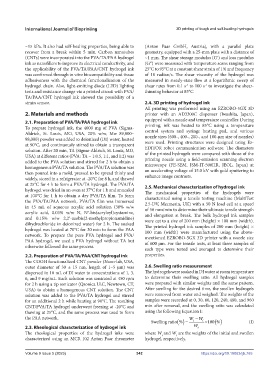
            thawing at 25°C, and the same process was used to form   using the following Equation I:
            the PAA network.                                                      W  W
                                                                  Swelling ratio %    t  i  100  %   (I)
            2.3. Rheological characterization of hydrogel ink                       W t
            The rheological properties of the hydrogel inks were   where W  and W  are the weights of the initial and swollen
                                                                            t
                                                                      i
            characterized using an MCR 102 Anton Paar rheometer   hydrogel, respectively.
            Volume 9 Issue 5 (2023)                        342                         https://doi.org/10.18063/ijb.765

