


Page 478 - IJB-9-6
P. 478
International Journal of Bioprinting                              Bioprinting cell-laden protein-based hydrogel


            the structure’s stability . The mechanism is thought to be   (typically titanium or gold) is deposited on top of the
                              [80]
            controlled via cell interactions and migrations, which is   donor substrate. In response to the absorption of energy,
            analyzed in some cases by means of phase field theory [83,84] .   bioink droplets of defined sizes are formed. Although
            Besides, cell aggregate maturation is a crucial step; in   this technique is capable of printing materials with high
            fact, changing the microenvironment in cell aggregates   viscosities and high cell densities at extremely high
            simulates tissue formation in vivo to accelerate maturation   resolutions, it is limited by its excessive cost and inability
                                                                                  [25]
            and generate stable, functional tissues .          to print large constructs . In this regard, a number of TE
                                          [85]
                                                               projects have been successfully performed using the multi-
               In  multi-cell  bioprinting,  subdivided  into  inkjet   cell bioprinting method [91-98] . Compared to cell aggregate
            bioprinting, extrusion-based  bioprinting,  and laser-  and single-cell bioprinting, Table 1 summarizes the benefits
            assisted bioprinting , cells are suspended in hydrogels   and drawbacks of this method.
                            [86]
            called bioinks . Employing this approach, cells are printed
                       [87]
            randomly according to their concentration percentage in   In summary, selecting the appropriate bioprinting
            the bioink, and a scaffold is created afterward . Inkjet   technique requires consideration of both the fabrication
                                                  [88]
            printing is based on the deposition of bioink drops in a   process and the cell requirements. Bioprinting of cell
            predetermined way to create a final multi-layer pattern.   aggregates is often necessary to produce large tissues
            As a result of thermal or piezoelectric changes, pressure   in size or have tight junctions between cells. The use of
            pulses generate drops with a defined volume in the   single-cell bioprinting permits researchers to deposit
            range  of picoliters. Commercial  thermal printers  utilize   microenvironment components and stem cells in precisely
            heating elements to expel ink droplets and form vapor   defined locations to study cell–matrix interactions. In
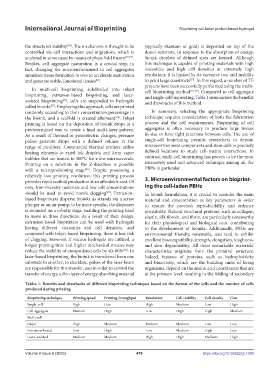
            bubbles that are heated to 300°C for a few microseconds.   contrast, multi-cell bioprinting has proven to be the most
            Printing  on  a substrate  in the  Z-direction  is possible   extensively used and advanced technique among all, for
            with  a micropositioning  stage . Despite possessing  a   PBHs in particular.
                                     [25]
            relatively low printing resolution, this printing process
            provides rapid scaffold production at an affordable cost. Of   3. Microenvironmental factors on bioprint-
            note, low-viscosity materials and low cell concentrations   ing the cell-laden PBHs
            should be used to avoid nozzle clogging . Extrusion-  In bioink formulation, it is crucial to consider the main
                                              [89]
            based bioprinters disperse bioinks as strands via a screw   material and concentration as key parameters in order
            plunger or an air pump; to be more specific, the dispenser   to ensure the process’s reproducibility and enhance
            is mounted on a robotic stage, enabling the printing head   printability. Natural structural proteins, such as collagen,
            to move in three directions. As a result of their design,   elastin, silk fibroin, and fibrin, are particularly noteworthy
            extrusion-based bioprinters can be used with hydrogels   for their physiological and biological cues, contributing
            having different viscosities and cell densities, and   to the development of bioinks. Additionally, PBHs are
            compared with inkjet-based bioprinting, there is less risk   environmental friendly, renewable, and tend to exhibit
            of clogging. However, if viscous hydrogels are utilized, a   excellent biocompatibility, strength, elongation, toughness,
            longer printing time and higher mechanical stresses may   and slow degradability. All these remarkable materials’
            reduce the viability of encapsulated cells by 40–80% . In   characteristics originate from the proteins’ structure.
                                                      [90]
            laser-based bioprinting, the bioink is transferred from one   Indeed, features of proteins, such as hydrophobicity
            substrate to another; to elucidate, pulses of the laser beam   and bioactivity, which are  the  building  units  of  living
            are responsible for this transfer, and in order to control the   organisms, depend on the amino acid constituents that are
            transfer of energy, a thin layer of energy-absorbing material   at the primary level, resulting in the folding of secondary

            Tables 1. Benefits and drawbacks of different bioprinting techniques based on the format of the cells and the number of cells
            produced during printing
             Bioprinting technique  Printing speed  Printing throughput  Resolution  Cell viability  Cell density  Cost
             Single-cell        High         Low               High         Medium      Low        High
             Cell aggregate     Medium       High              Low          High        High       Medium
             Multi-cell
             Inkjet             High         Medium            Medium       Medium      Low        Low
             Extrusion-based    Low          High              Low          Medium      High       Low
             Laser-assisted     Medium       Medium            High         High        Medium     High


            Volume 9 Issue 6 (2023)                        470                          https://doi.org/10.36922/ijb.1089

