


Page 479 - IJB-9-6
P. 479
International Journal of Bioprinting                              Bioprinting cell-laden protein-based hydrogel


            structures  into the  tertiary  3D configuration.  Notably,   the microenvironment may affect the protein structures.
            proteins have functional amino and carboxyl groups that   For example, remodeling of the  initial hydrogel matrix
            can be utilized to convert these materials into hydrogels by   can happen as a function of incorporating the cells and
            enzymatic, chemical, and physical crosslinking methods.   secretion of native ECM [100] . Besides, hydrogel degradation
            The unfolding of protein and its accumulation into a gel   and swelling can impact the bioprinted construct’s
            matrix is the most frequent process in protein gelation,   integrity [101] . Thus, careful consideration should be given to
            leading to alterations in conformation from the third to the   several important biophysical cues, such as composition,
            second structure and the subsequent rise in random coil   biodegradation,  porosity-related  parameters,  and
            content. Specifically, the structural changes in proteins for   crosslinking process. Furthermore, chemical structure,
            the PBHs’ formation are owing to the secondary structure   the presence of GFs and signaling molecules, as well as
            content’s alterations, and proteins’ carboxyl and amino   cell signaling, must be taken into account in the case of
            groups can form a hydrophilic environment, resulting   biochemical cues. All in all, the PBHs should meet several
                                                    [21]
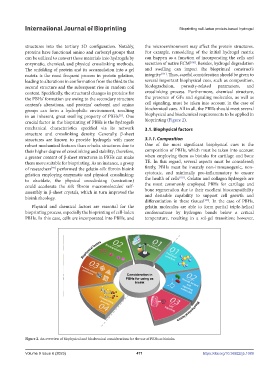
            in an inherent, great swelling property of PBHs . One   biophysical and biochemical requirements to be applied in
            crucial factor in the bioprinting of PBHs is the hydrogel’s   bioprinting (Figure 2).
            mechanical characteristics specified via its network   3.1. Biophysical factors
            structure and crosslinking density. Generally, β-sheet
            structures are known to provide hydrogels with more   3.1.1. Composition
            robust mechanical features than α-helix structures due to   One of the most significant biophysical cues is the
            their higher degree of crosslinking and stability; therefore,   composition of PBHs, which must be taken into account
            a greater content of β-sheet structures in PBHs can make   when employing them as bioinks for cartilage and bone
            them more suitable for bioprinting. As an instance, a group   TE. In this regard, several aspects must be considered;
            of researchers  performed the gelatin-silk fibroin bioink   firstly,  PBHs  must  be  innately  non-immunogenic,  non-
                       [99]
            gelation employing enzymatic and physical crosslinking;   cytotoxic, and minimally pro-inflammatory to ensure
            to elucidate, the physical crosslinking (sonication)   the health of cells [102] . Gelatin and collagen hydrogels are
            could  accelerate the  silk  fibroin  macromolecules’ self-  the most commonly employed PBHs for cartilage and
            assembly in β-sheet crystals, which in turn improved the    bone regeneration due to their excellent biocompatibility
            bioink rheology.                                   and desirable capability to support cell growth and
                                                               differentiation in these tissues [103] . In the case of PBHs,
               Physical and chemical factors are essential for the   gelatin molecules are able to form partial triple-helical
            bioprinting process, especially the bioprinting of cell-laden   conformations by  hydrogen  bonds  below  a  critical
            PBHs. In this case, cells are incorporated into PBHs, and   temperature, resulting in a sol-gel transition; however,


            Figure 2. An overview of biophysical and biochemical considerations for the use of PBHs as bioinks.


            Volume 9 Issue 6 (2023)                        471                          https://doi.org/10.36922/ijb.1089

