


Page 477 - IJB-9-6
P. 477
International Journal of Bioprinting                              Bioprinting cell-laden protein-based hydrogel


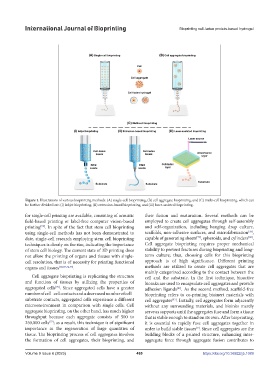
            Figure 1. Illustrations of various bioprinting methods: (A) single-cell bioprinting, (B) cell aggregate bioprinting, and (C) multi-cell bioprinting, which can
            be further divided into (i) inkjet bioprinting, (ii) extrusion-based bioprinting, and (iii) laser-assisted bioprinting.
            for single-cell printing are available, consisting of acoustic   their  fusion  and  maturation.  Several  methods  can  be
            field-based printing or label-free computer vision-based   employed to create cell aggregates through self-assembly
            printing . In spite of the fact that stem cell bioprinting   and self-organization, including hanging drop culture,
                  [73]
                                                                                                           [78]
            using single-cell methods has not been demonstrated to   scaffolds, non-adhesive surfaces, and microfabrication ,
                                                                                     [79]
                                                                                                           [80]
            date, single-cell research employing stem cell bioprinting   capable of generating sheets , spheroids, and cylinders .
            techniques is clearly on the rise, indicating the importance   Cell aggregate bioprinting requires proper mechanical
            of stem cell biology. The current state of 3D printing does   stability to prevent fractures during bioprinting and long-
            not allow the printing of organs and tissues with single-  term culture; thus, choosing cells for this bioprinting
            cell resolution, that is of necessity for printing functional   approach is of high significance. Different printing
            organs and tissues [68,69,74,75] .                 methods are utilized to create cell aggregates that are
                                                               mainly categorized according to the contact between the
               Cell aggregate bioprinting is replicating the structure   cell and the substrate. In the first technique, bioactive
            and function of tissues by utilizing the properties of   bioinks are used to encapsulate cell aggregates and provide
            aggregated cells . Since aggregated cells have a greater   adhesion ligands . As the second method, scaffold-free
                         [76]
                                                                            [81]
            number of cell–cell contacts and a decreased number of cell–  bioprinting refers to co-printing bioinert materials with
            substrate contacts, aggregated cells experience a different   cell aggregates . Initially, cell aggregates form adjacently
                                                                          [82]
            microenvironment in comparison with single cells. Cell   without any surrounding materials, and bioinks merely
            aggregate bioprinting, on the other hand, has much higher   serve as supports until the aggregates fuse and form a tissue
            throughput because each aggregate consists of 500 to   that is stable enough to stand on its own. After bioprinting,
            250,000 cells ; as a result, this technique is of significant   it is essential to rapidly fuse cell aggregates together in
                      [77]
            importance in the regeneration of large quantities of   order to build stable tissues . Since cell aggregates are the
                                                                                     [9]
            tissue. The bioprinting process of cell aggregates involves   building blocks of a printed structure, enhancing inter-
            the  formation  of  cell  aggregates,  their  bioprinting,  and   aggregate force through aggregate fusion contributes to

            Volume 9 Issue 6 (2023)                        469                          https://doi.org/10.36922/ijb.1089

