


Page 36 - IJOCTA-15-1
P. 36
S. Ben Hanachi, B. Sellami, M. Belloufi / IJOCTA, Vol.15, No.1, pp.25-34 (2025)
                                                              with an Intel(R) Core(TM) i3-4030U CPU @ 1.90
                   hyb                BA      HZ              GHz, 4GB RAM, running Windows seven profes-
                ∥d    ∥ ≤ ∥g k+1 ∥ + (|β  | + |β  |)∥d k ∥,
                   k+1                k       k
                                                              sional.
                                 ∥s k ∥     MD
                        ≤ Γ + M       ≤ Γ +      ,
                                  λ           λ
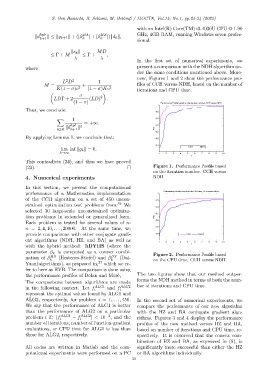
                                                              In the first set of numerical experiments, we
            where                                             present a comparison with the NDH algorithm un-
                                                              der the same conditions mentioned above. More-
                                                              over, Figures 1 and 2 show the performance pro-
                              2
                             L D 2           1
                     M =              +                       files of CCH versus NDH, based on the number of
                          K(1 − σ)c 2   (1 − σ)Kc 2           iterations and CPU time.

                                    σ         2
                         LDΓ + 2         (LD)    .
                                  (1 − σ)                               Performance Profile based on the iteration number, CCH versus NDH.
                                                                       1
            Thus, we conclude:
                                                                      0.9
                                 1                                    0.8
                          X
                                      = +∞.
                                hyb  2                                0.7
                              ∥d   ∥
                          k≥0   k+1                                   P(f)
                                                                      0.6
            By applying Lemma 1, we conclude that:                    0.5
                                                                      0.4
                                                                                     CCH  NDH
                            lim inf ∥g k ∥ = 0.
                           k→∞                                         1    2  3  4  5  6  7  8  9  10
                                                                                      f
            This contradicts (24), and thus we have proved
            (23).                                        □           Figure 1. Performance Profile based
                                                                     on the iteration number. CCH versus
            4. Numerical experiments                                 NDH
            In this section, we present the computational
                                                                          Performance Profile based on the CPU time, CCH versus NDH.
            performance of a Mathematica implementation                1
            of the CCH algorithm on a set of 450 uncon-               0.9
            strained optimization test problems from. 32  We
                                                                      0.8
            selected 30 large-scale unconstrained optimiza-
                                                                      0.7
            tion problems in extended or generalized form.            P(f)
                                                                      0.6
            Each problem is tested for several values of n:
            n = 2, 4, 10, . . . , 20000. At the same time, we         0.5
            provide comparisons with other conjugate gradi-           0.4           CCH  NDH
            ent algorithms (NDH, HZ, and BA) as well as
                                                                       1   2  3  4  5  6   7  8  9  10
                                                                                      f
            with the hybrid method: hDYHS (where the
            parameter β k is computed as a convex combi-             Figure 2. Performance Profile based
            nation of β HS  (Hestenes-Stiefel) and β DY  (Dai-
                       k                          k                  on the CPU time. CCH versus NDH
            Yuan)algorithms), as proposed in, 27  which we re-
            fer to here as HYB. The comparison is done using
            the performance profiles of Dolan and Mor´e,      The two figures show that our method outper-
                                                              forms the NDH method in terms of both the num-
            The comparisons between algorithms are made
            in the following context. Let f ALG1  and f ALG2  ber of iterations and CPU time.
                                           i          i
            represent the optimal values found by ALG1 and
            ALG2, respectively, for problem i = 1, . . . , 450.  In the second set of numerical experiments, we
            We say that the performance of ALG1 is better     compare the performance of our new algorithm
            than the performance of ALG2 on a particular      with the HZ and BA conjugate gradient algo-
            problem i if: |f i ALG1  − f i ALG2 | < 10 −3 , and the  rithms. Figures 3 and 4 display the performance
            number of iterations, number of function-gradient  profiles of the new method versus HZ and BA,
            evaluations, or CPU time for ALG1 is less than    based on number of iterations and CPU time, re-
            those for ALG2, respectively.                     spectively. It is observed that the convex com-
                                                              bination of HZ and BA, as expressed in (8), is
            All codes are written in Matlab and the com-      significantly more successful than either the HZ
            putational experiments were performed on a PC     or BA algorithms individually.
                                                            30

