


Page 37 - IJOCTA-15-1
P. 37
Global convergence property with inexact line search for a new conjugate gradient method

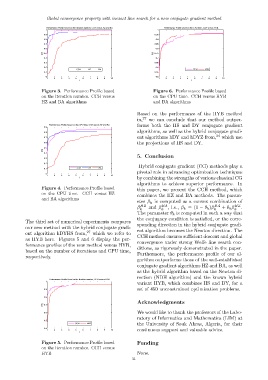
                      Performance Profile based on the iteration number, CCH versus HZ and BA.  Performance Profile IJsed on the CPU time, CCH versus HYB.
                     1                                                 1
                     0.9                                              0.95
                     0.8                                              0.9
                     0.7                                              0.85
                     0.6                                              0.8
                    P(f)  0.5                                        P(f)  0.75
                     0.4                                              0.7
                     0.3                                              0.65
                     0.2                                              0.6
                                   CCH  HZ   BA                                        CCH  HYB
                     0.1                                              0.55
                     0                                                0.5
                      1  2  3  4   5  6  7  8  9  10                   1   2  3  4  5  6   7  8  9  10
                                    f                                                 f
                    Figure 3. Performance Profile based              Figure 6. Performance Profile based
                    on the iteration number. CCH versus              on the CPU time. CCH versus HYB
                    HZ and BA algorithms                             and BA algorithms

                                                              Based on the performance of the HYB method
                                                              in, 27  we can conclude that our method outper-
                       Performance Profile based on the CPU time, CCH versus HZ and BA.  forms both the HS and DY conjugate gradient
                     0.9
                                                              algorithms, as well as the hybrid conjugate gradi-
                     0.8
                                                              ent algorithms hDY and hDYZ from,  34  which use
                     0.7
                                                              the projections of HS and DY.
                     0.6
                     0.5
                    P(f)
                     0.4
                                                              5. Conclusion
                     0.3
                     0.2
                                                               Hybrid conjugate gradient (CG) methods play a
                                   CCH  HZ   BA
                     0.1
                                                              pivotal role in advancing optimization techniques
                     0
                      1  2  3  4   5  6  7  8  9  10
                                    f                         by combining the strengths of various classical CG
                                                              algorithms to achieve superior performance. In
                    Figure 4. Performance Profile based       this paper, we present the CCH method, which
                    on the CPU time. CCH versus HZ
                                                              combines the HZ and BA methods. The param-
                    and BA algorithms
                                                              eter β k is computed as a convex combination of
                                                              β HZ  and β BA , i.e., β k = (1 − θ k )β BA  + θ k β HZ  .
                                                               k         k                      k        k
                                                              The parameter θ k is computed in such a way that
                                                              the conjugacy condition is satisfied, or the corre-
            The third set of numerical experiments compares
                                                              sponding direction in the hybrid conjugate gradi-
            our new method with the hybrid conjugate gradi-   ent algorithm becomes the Newton direction. The
            ent algorithm hDYHS from,   27  which we refer to
                                                              CCH method ensures sufficient descent and global
            as HYB here. Figures 5 and 6 display the per-
                                                              convergence under strong Wolfe line search con-
            formance profiles of the new method versus HYB,
                                                              ditions, as rigorously demonstrated in the paper.
            based on the number of iterations and CPU time,   Furthermore, the performance profile of our al-
            respectively.
                                                              gorithm outperforms those of the well-established
                                                              conjugate gradient algorithms HZ and BA, as well
                                                              as the hybrid algorithm based on the Newton di-
                                                              rection (NDH algorithm) and the known hybrid
                       Performance Profile IJsed on the iteration number, CCH versus HYB.
                     1
                                                              variant HYB, which combines HS and DY, for a
                                                              set of 450 unconstrained optimization problems.
                     0.9
                     0.8
                                                              Acknowledgments
                    P(f)  0.7
                                                              We would like to thank the professors of the Labo-
                     0.6
                                                              ratory of Informatics and Mathematics (LIM) at
                     0.5
                                  CCH   HYB                   the University of Souk Ahras, Algeria, for their
                     0.4
                      1  2  3  4   5  6  7  8  9  10          continuous support and valuable advice.
                                    f
                    Figure 5. Performance Profile based       Funding
                    on the iteration number. CCH versus
                    HYB                                       None.
                                                            31

