


Page 42 - IJOCTA-15-1
P. 42
L.K. Yadav et.al. / IJOCTA, Vol.15, No.1, pp.35-49 (2025)
Integral transformations undeniably stand out that the proposed scheme can reduce computa-
as one of the most beneficial and efficient tech- tion time and workload compared to other tradi-
niques in theoretical and applied mathemat- tional techniques, all while maintaining high ef-
ics, finding numerous applications in fields such ficiency. These equations have been previously
as biology, 9–12 electrodynamics, 13 mechanics, 14 studied and analyzed by various authors using dif-
biotechnology, 15 chaos theory, 16 and others. 17–20 ferent techniques such as ADM, 34 VIM, 35 coupled
In recent years, various integral transforms, such fractional reduced differential transform method
as Laplace transform, 21,22 Elzaki transform, 23,24 (CFRDTM), 6 Laplace Adomian decomposition
1
Yang integral transform, 25 Aboodh transform 26 method (LADM), optimal homotopy asymptotic
7
4
Sumudu transform 27 etc. have been employed for method, Residual power series method, New it-
solving different physical models. erative method 36 and other approaches. 37,38
2. Definitions
The WBK equations describe the propagation of
shallow water waves 28 and exhibit different dis- In this section, some important definitions re-
persion relations. The coupled scheme of these lated to the fractional Caputo derivative and the
equations was developed by Whitham, 29 Broer, 30 Shehu transform are provided to facilitate an un-
and Kaup. 31 The time fractional coupled WBK derstanding of the subsequent results.
equations, incorporating the fractional order Ca-
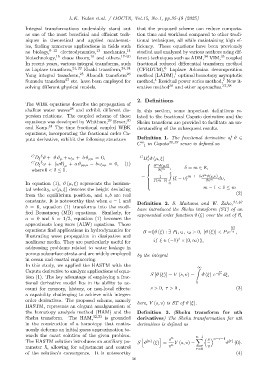
puto derivative, exhibit the following structure Definition 1. The fractional derivative of ϑ ∈
C m in Caputo 30,39 sense is defined as
−1
C δ C δ
D ξ ϑ + ϑ ϑ µ + ω µ + b ϑ µµ = 0, D ϑ (µ, ξ)
δ
C D ξ ω + (ωϑ) + a ϑ µµµ − b ω µµ = 0, (1) τ
m
µ ∂ ϑ(µ,ξ)
where 0 < δ ≤ 1 . ∂ξ m , δ = m ∈ ℵ,
ξ
m
= 1 R (ξ − υ) m−1−δ ∂ ϑ(χ,υ) dυ,
Γ(m−δ) ∂υ m
In equation (1), ϑ (µ, ξ) represents the horizon- 0
m − 1 < δ ≤ m
tal velocity, ω (µ, ξ) denotes the height deviating
(2)
from the equilibrium position, and a, b are real
constants. It is noteworthy that when a = 1 and 31,40
Definition 2. S. Maitama and W. Zaho,
b = 0, equation (1) transforms into the modi-
have introduced the Shehu transform (ST) of an
fied Boussinesq (MB) equations. Similarly, for
exponential order function ϑ (ξ) over the set of B,
a = 0 and b = 1/2, equation (1) becomes the
approximate long wave (ALW) equations. These
|ξ|
equations find applications in hydrodynamics for B ={ϑ (ξ) : ∃ P 1 , ς 1 , ς 2 > 0, |ϑ (ξ)| < P 1 e ς j ,
illustrating wave propagation in dissipative and j
nonlinear media. They are particularly useful for if ξ ∈ (−1) × [0, ∞) },
addressing problems related to water leakage in
porous subsurface strata and are widely employed by the integral
in ocean and coastal engineering.
In this study, we applied the HASTM with the ∞
Caputo derivative to analyze applications of equa- Z −sτ
S [ϑ (ξ)] = V (s, v) = ϑ (ξ) e v dξ,
tion (1). The key advantage of employing a frac-
tional derivative model lies in its ability to ac- 0
count for memory, history, or non-local effects: s > 0, τ > 0 , (3)
a capability challenging to achieve with integer-
order derivatives. The proposed scheme, namely
here, V (s, v) is ST of ϑ (ξ).
HASTM, represents an elegant amalgamation of
the homotopy analysis method (HAM) and the Definition 3. (Shehu transform for nth
Shehu transform. The HAM, 32,33 is grounded derivatives) The Shehu transformation for nth
in the construction of a homotopy that contin- derivatives is defined as
uously deforms an initial guess approximation to-
wards the exact solution of the given problem.
s
h i s n n−1 n−r−1
X
The HASTM solution introduces an auxiliary pa- S ϑ (n) (ξ) = V (s, v) − ϑ (r) (0).
rameter ℏ, allowing for adjustment and control v n r=0 v
of the solution’s convergence. It is noteworthy (4)
36

