


Page 43 - IJOCTA-15-1
P. 43
Approximate analytical solutions of fractional coupled Whitham-Broer-Kaup equations . . .

            Definition 4. The Shehu transform of the Ca-      and q. Liao, 32,33  constructed the zeroth-order de-
            puto derivative is given as [31]                  formation equation as:

                                s
              h           i     δ
                  δ
            S  C D ϑ (µ, ξ) =      V (µ, s, v)                    ℏq N [Y (µ, ξ; q)]
                  ξ
                                v
                                                                  = (1 − q) S [[Y (µ, ξ; q)] − ϑ 0 (µ, ξ)] .  (10)
                                m−1
                                 X    s  δ−r−1
                              −               ϑ (r)  (µ, 0) .
                                      v
                                 r=0                          Evidently, for q = 0 and q = 1 in equation (10),
                                                        (5)   the following results holds
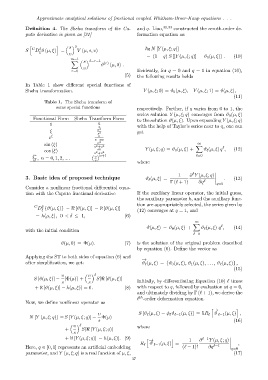
            In Table 1 show different special functions of
            Shehu transformation.                                Y (µ, ξ; 0) = ϑ 0 (µ, ξ),  Y (µ, ξ; 1) = ϑ(µ, ξ),
                                                                                                         (11)
                     Table 1. The Shehu transform of
                          some special functions              respectively. Further, if q varies from 0 to 1, the
                                                              series solution Y (µ, ξ; q) converges from ϑ 0 (µ, ξ)
                Functional Form   Shehu Transform Form        to the solution ϑ(µ, ξ). Upon expanding Y (µ, ξ; q)
                       1                     v
                                             s 2              with the help of Taylor’s series near to q, one can
                       ξ                    v                 get
                                            s 2
                       e ξ                   v
                                           s−av
                     sin (ξ)                v 2                                          ∞
                                            2
                                           s +v 2                                       X           ℓ
                     cos (ξ)                sv                   Y (µ, ξ; q) = ϑ 0 (µ, ξ) +  ϑ ℓ (µ, ξ)q ,  (12)
                                            2
                                           s +v 2
                ξ n                        v n+1                                        ℓ=0

                n!  , n = 0, 1, 2, ....    s
                                                              where
                                                                                       ℓ
                                                                                1    ∂ Y (µ, ξ; q)
            3. Basic idea of proposed technique                   ϑ ℓ (µ, ξ) =                     .    (13)
                                                                             Γ (ℓ + 1)   ∂q ℓ
                                                                                                 q=0
            Consider a nonlinear fractional differential equa-
            tion with the Caputo fractional derivative        If the auxiliary linear operator, the initial guess,
                                                              the auxiliary parameter ℏ, and the auxiliary func-
                                                              tion are appropriately selected, the series given by
                C   δ
                  D {ϑ(µ, ξ)} − ℜ [ϑ(µ, ξ)] − ℵ [ϑ(µ, ξ)]
                    ξ                                         (12) converges at q = 1, and
                 = h(µ, ξ), 0 < δ ≤ 1,                  (6)
                                                                                        ∞
                                                                                       X
                                                                                                   ℓ
                                                                  ϑ(µ, ξ) = ϑ 0 (µ, ξ) +  ϑ ℓ (µ, ξ) q ,  (14)
            with the initial condition
                                                                                       ℓ=0
                            ϑ(µ, 0) = Φ(µ).             (7)   is the solution of the original problem described
                                                              by equation (6). Define the vector as
            Applying the ST to both sides of equation (6) and   − →
            after simplification, we get:                       ϑ ℓ (µ, ξ) = {ϑ 0 (µ, ξ), ϑ 1 (µ, ξ), . . . , ϑ ℓ (µ, ξ)} ,
                                                                                                         (15)
                            υ            δ
                                        υ
                S [ϑ(µ, ξ)] −  [Φ(µ)] +     S[ℜ [ϑ(µ, ξ)]
                            s           s                     Initially, by differentiating Equation (10) ℓ times
                 + ℵ [ϑ(µ, ξ)] − h(µ, ξ)] = 0 .         (8)   with respect to q, followed by evaluation at q = 0,
                                                              and ultimately dividing by Γ (ℓ + 1), we derive the
                                                               th
                                                              ℓ -order deformation equation.
            Now, we define nonlinear operator as
                                                                                                − →
                                                                                               h          i
                                             υ                 S [ϑ ℓ (µ, ξ) − ϕ ℓ ϑ ℓ−1 (µ, ξ)] = ℏR ℓ ϑ ℓ−1 (µ, ξ) ,
              N [Y (µ, ξ; q)] = S [Y (µ, ξ; q)] −  Φ(µ)
                                             s                                                           (16)
                                  υ                           where
                                  δ
                              +      S[ℜ [Y (µ, ξ; q)]
                                  s
                              + ℵ [Y (µ, ξ; q)] − h(µ, ξ)]. (9)   h − →      i       1    ∂ ℓ−1
                                                               R ℓ ϑ ℓ−1 (µ, ξ) =             Y (µ, ξ; q)    ,
            Here, q ∈ [0, 1] represents an artificial embedding                   (ℓ − 1)!    ∂q ℓ−1    q=0
            parameter, and Y (µ, ξ; q) is a real function of µ, ξ,                                       (17)
                                                            37

