


Page 155 - IJOCTA-15-2
P. 155
A. Yoku¸s, H. Durur, M.H. Ekici / IJOCTA, Vol.15, No.2, pp.343-353 (2025)
                                                                  A higher diffusion coefficient allows matter
                                                              or energy to diffuse more rapidly through the
                                                              medium. This is especially important in media
                                                              where the speed of propagation of the wave is a
                                                              significant factor. Different diffusion coefficients
                                                              also affect the amount of energy carried by the
                                                              wave. A higher diffusion coefficient will distrib-
                                                              ute the energy of the wave over a wider area
                                                              more quickly, while a lower diffusion coefficient
                                                              will cause the energy to remain more localized.
                                                              The diffusion coefficient has a significant influence
                                                              on the propagation characteristics of the wave.
                                                              However, to determine exactly how these effects
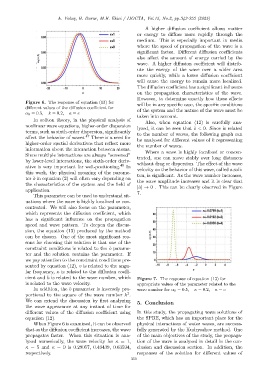
            Figure 6. The response of equation (13) for       will be in any specific case, the specific conditions
            different values of the diffusion coefficient for  of the system and the nature of the wave must be
            α 0 = 0.5,  k = 0.2,  a = e
                                                              taken into account.
                In soliton theory, in the physical analysis of
                                                                  Also, when equation (12) is carefully ana-
            nonlinear wave equations, higher-order dispersion  lyzed, it can be seen that `o < 0. Since is related
            terms, such as sixth-order dispersion, significantly  to the number of waves, the following graph can
            affect the behavior of waves. 47  There is a need for
                                                              be analyzed for different values of k representing
            higher-order spatial derivatives that reflect more
                                                              the number of waves.
            information about the interaction between atoms.      Where a wave is highly localized or concen-
            Since multiple interactions are always ”screened”  trated, one can move stably over long distances
            by lower-level interactions, the sixth-order deriv-  without drag or dispersion. The effect of the wave
            ative is very important for well-positioning. 49  In  velocity on the behavior of this wave, called a soli-
            this work, the physical meaning of the parame-    ton, is significant. As the wave number increases,
            ter `o in equation (2) will often vary depending on  the wave amplitude increases and it is clear that
            the characteristics of the system and the field of  |`o| → 0 . This can be clearly observed in Figure
            application.                                      7.
                This parameter can be used to understand sit-
            uations where the wave is highly localized or con-
            centrated. We will also focus on the parameter,
            which represents the diffusion coefficient, which
            has a significant influence on the propagation
            speed and wave pattern. To deepen the discus-
            sion, the equation (13) produced by the method
            can be chosen. One of the most significant rea-
            sons for choosing this solution is that one of the
            constraint conditions is related to the `o parame-
            ter and the solution contains the parameter. If
            we pay attention to the constraint conditions pre-
            sented by equation (12), v is related to the angu-
            lar frequency, κ is related to the diffusion coeffi-
            cient and k is related to the wave number, which  Figure 7. The response of equation (13) for
            is related to the wave velocity.                  appropriate values of the parameter related to the
                In addition, the `o parameter is inversely pro-  wave number for α 0 = 0.5,  κ = 0.2,  a = e
                                                          2
            portional to the square of the wave number k .
            We can extend the discussion by first analyzing
                                                              5. Conclusion
            the wave appearance at any instant of time for
            different values of the diffusion coefficient using  In this study, the propagating wave solutions of
            equation (12).                                    the SPBE, which has an important place for the
                When Figure 6 is examined, it can be observed  physical interactions of water waves, are success-
            that as the diffusion coefficient increases, the wave  fully generated by the Kudryashov method. One
            propagates faster. When this situation is ana-    of the main objectives of the study, the propaga-
            lyzed numerically, the wave velocity for κ = 1,   tion of the wave is analyzed in detail in the con-
            κ = 5 and κ = 9 is 0.29057, 0.49439, 0.63594,     clusion and discussion section. In addition, the
            respectively.                                     responses of the solution for different values of
                                                           350

