


Page 133 - IJOCTA-15-3
P. 133
A novel ninth-order root-finding algorithm for nonlinear equations with implementations in various ...
            iteration, which consist of two function evalua-  Kalantari and Hans Lee, 38  the modifications in-
            tions and two first-order derivatives.            corporated into our algorithm are both intentional
                                                              and significant. Specifically, the correction step of
                              f(x n )                         the proposed method employed an exponential-
                   y n = x n −      ,  n = 0, 1, 2, . . .  (3)
                               ′
                              f (x n )                        based refinement, a distinctive enhancement ab-
                                                              sent in Kalantari and Hans Lee. 38  This refinement
                                            ′
                                  2f(x n )f(y n )f (y n )     modifies the intermediate estimate using an ex-
            x n+1 = y n −
                            ′
                                    ′
                                                        ′
                                               ′
                                2
                                       2
                      2f(x n )f (y n ) − f (x n ) f(y n ) + f (x n )f(y n )f (y n )  ponential transformation of the residual, which
                                                        (4)
                                                              contributes to a broader region of attraction, im-
                Another new method proposed was based on      proved numerical stability, and reduced sensitiv-
            ExpM,  13  which provides faster root convergence
                                                              ity to initial guesses. These advantages are partic-
            compared to existing algorithms. The proposed
                                                              ularly important for nonlinear problems charac-
            algorithm ExpM is particularly useful for com-
                                                              terized by steep gradients or closely spaced roots.
            puting the real roots of transcendental equations
                                                              The effectiveness of this modification was demon-
            (13).
                                                              strated through detailed polynomiographic visu-
                                                              alizations, semi-local convergence analysis, and its

                               −f(x n )
               x n+1 = x n exp           ,  n = 0, 1, 2, . . .  application to a real-world engineering problem
                                  ′
                              x n f (x n )                    involving open-channel flow. Collectively, these
                                                        (5)   results highlight that the novelty of the proposed
                The following section presents the proposed   method lies not only in preserving the high order
            algorithm for solving nonlinear equations.        of convergence and computational efficiency but
                                                              also in delivering enhanced robustness, accuracy,
            2. Proposed algorithm
                                                              and stability in practical scenarios.
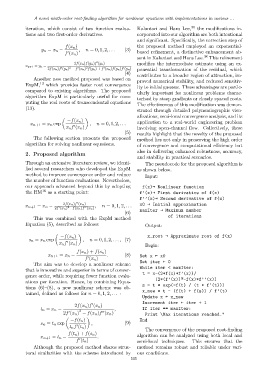
            Through an extensive literature review, we identi-    The pseudocode for the proposed algorithm is
            fied several researchers who developed the ExpM   as shown below.
            method to improve convergence order and reduce        Input:
            the number of function evaluations. Nevertheless,
            our approach advanced beyond this by adopting       f(x)→ Nonlinear function
            the HM  16  as a starting point:                   f’(x)→ First derivative of f(x)
                                                               f’’(x)→ Second derivative of f(x)
                                   ′
            x n+1 = x n −    2f(x n)f (x n)  ,  n = 0, 1, 2, . . .  x0 → Initial approximation
                                       ′′
                           ′
                               2
                         2f (x n) −f(x n)f (x n)
                                                        (6)    maxIter → Maximum number
                                                                            of iterations
                This was combined with the ExpM method
            Equation (5), described as follows:                   Output:

                            −f(x n )                               x_root → Approximate root of f(x)
              s n = x n exp           ,  n = 0, 1, 2, . . . , (7)
                               ′
                           x n f (x n )
                                                                  Begin:
                                   f(x n ) + f(s n )
                      x n+1 = x n −             .       (8)    Set x ← x0
                                        ′
                                       f (x n )
                                                               Set iter ← 0
                The aim was to develop a nonlinear scheme
                                                               While iter < maxIter:
            that is innovative and superior in terms of conver-
                                                                t = x-(2*f(x)*f’(x))/
            gence order, while requiring fewer function evalu-
                                                                      (2*(f’(x))²-f(x)*f’’(x))
            ations per iteration. Hence, by combining Equa-
                                                                s = t * exp(-f(t) / (t * f’(t)))
            tions (6)–(8), a new nonlinear scheme was ob-
                                                                x_new = t - (f(t) + f(s)) / f’(t)
            tained, defined as follows for n = 0, 1, 2, . . . :
                                                                Update x ← x_new
                                          ′
                                  2f(x n )f (x n )              Increment iter ← iter + 1
                   t n = x n −      2               ,           If iter == maxIter:
                                ′
                                              ′′
                             2f (x n ) − f(x n )f (x n )         Print \Max iterations reached."

                                −f(t n )                       End
                   s n = t n exp          ,             (9)
                                   ′
                                t n f (t n )
                                                                  The convergence of the proposed root-finding
                               f(t n ) + f(s n )
                   x n+1 = t n −            .                 algorithm can be analyzed using both local and
                                    ′
                                   f (t n )                   semi-local techniques.  This ensures that the
                Although the proposed method shares struc-    method remains robust and reliable under vari-
            tural similarities with the scheme introduced by  ous conditions.
                                                           505

