


Page 137 - IJOCTA-15-3
P. 137
A novel ninth-order root-finding algorithm for nonlinear equations with implementations in various ...
                From this, we obtained an approximate value   speed compared to these existing methods, show-
            of h = 1.465091220. However, Equation (17) was    casing its efficiency and robustness. While Table
            also solved in Kalantari and Hans Lee, 38  where  2 demonstrates that the proposed method typi-
            the approximate solution was obtained after four  cally requires fewer or equal iterations compared
            iterations using the same data. Therefore, the    to existing methods, it is important to note that
            proposed algorithm is more efficient than the one  the number of iterations alone does not fully cap-
            presented by Kalantari and Hans Lee. 38           ture an algorithm’s overall effectiveness. There-
                Lastly, Example 4 presents a performance      fore, several additional performance metrics have
            comparison between the proposed algorithm and     been evaluated to provide a more comprehen-
            existing methods, highlighting its efficiency. Con-  sive assessment. The proposed method not only
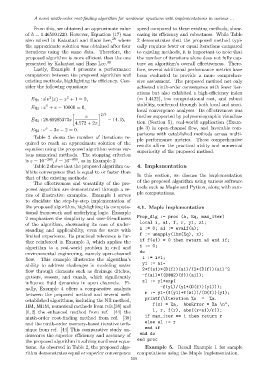
            sider the following equations:                    achieved ninth-order convergence with fewer iter-
                                                              ations but also exhibited a high-efficiency index
                               2
                       2
               Eq 1 : sin (x) − x + 1 = 0,                    (≈ 1.4422), low computational cost, and robust
                      5
               Eq 2 : x + x − 10000 = 0,                      stability, confirmed through both local and semi-
                                                              local convergence analyses. Its effectiveness was
                                             2/3
                                       x                      further supported by polynomiographic visualiza-
               Eq 3 : 28.69285373x               − 14.15,
                                  4.572 + 2x                  tion (Section 5), real-world application (Exam-
                     x
               Eq 4 : e − 3x − 2 = 0.                         ple 3) in open-channel flow, and favorable com-
                                                              parisons with established methods across multi-
                Table 2 shows the number of iterations re-    ple performance metrics. These comprehensive
            quired to reach an approximate solution of the
                                                              results affirm the practical utility and numerical
            equation using the proposed algorithm versus var-
                                                              superiority of the proposed method.
            ious numerical methods. The stopping criterion
            is ε = 10 −200 , δ = 10 −600 , as in Example 2
                Table 2 shows that the proposed algorithm ex-  4. Implementation
            hibits convergence that is equal to or faster than
                                                              In this section, we discuss the implementation
            that of the existing methods.
                The effectiveness and versatility of the pro-  of the proposed algorithm using various software
            posed algorithm are demonstrated through a se-    tools such as Maple and Python, along with sam-
            ries of illustrative examples. Example 1 serves   ple computations.
            to elucidate the step-by-step implementation of
            the proposed algorithm, highlighting its computa-  4.1. Maple implementation
            tional framework and underlying logic. Example
                                                              Prop_Alg := proc (a, Eq, max_iter)
            2 emphasizes the simplicity and user-friendliness
                                                               local i, a1, f, r, y1, z1;
            of the algorithm, showcasing its ease of under-
                                                               i := 0; a1 := evalf(a);
            standing and applicability, even for users with
                                                               f := unapply(lhs(Eq), x);
            limited experience. Its practical relevance is fur-
                                                               if f(a1) = 0 then return a1 end if;
            ther reinforced in Example 3, which applies the
                                                               i := 0;
            algorithm to a real-world problem in civil and
            environmental engineering, namely open-channel     do
            flow.  This example illustrates the algorithm’s     i := i+1;
            ability to address challenges in modeling water     y1 := a1-
            flow through elements such as drainage ditches,     2*f(a1)*(D(f))(a1)/(2*(D(f))(a1)^2
            gutters, sewers, and canals, which significantly    -f(a1)*((D@@2)(f))(a1));
            influence fluid dynamics in open channels. Fi-      z1 := y1*exp(
                                                                        -f(y1)/(y1*(D(f))(y1)));
            nally, Example 4 offers a comparative analysis
                                                                 r := y1-(f(y1)+f(z1))/(D(f))(y1);
            between the proposed method and several well-
                                                                 printf(\Iteration %a      =  %a.
            established algorithms, including the NR method,
                                                                     f(x) = %a,    AbsError = %a \n",
            HM, MHM, numerical methods from refs.[38] and
                                                                     i, r, f(r), abs((r-a1)/r));
            [1, 2] the enhanced method from ref.    [44] the
                                                                 if max_iter == i then return r
            ninth-order root-finding method from ref. [38]
                                                                 else a1 := r
            and the ninth-order memory-based iterative tech-
                                                                 end if
            nique from ref. [44] This comparative study un-
                                                               end do
            derscores the superior efficiency and accuracy of
                                                              end proc
            the proposed algorithm in solving nonlinear equa-
            tions. As observed in Table 2, the proposed algo-     Example 5. Recall Example 1 for sample
            rithm demonstrates equal or superior convergence  computations using the Maple implementation.
                                                           509

