


Page 141 - IJOCTA-15-3
P. 141
A novel ninth-order root-finding algorithm for nonlinear equations with implementations in various ...
            and computation time (in seconds). The results    trade-off between computational time and accu-
            clearly demonstrate that the proposed method      racy, making it particularly well-suited for real-
            efficiently handles increasing polynomial com-    world applications that demand both precision
            plexity while maintaining an exceptional balance  and efficiency.
            between accuracy and computational efficiency,        In summary, the proposed iterative method
            making it a highly reliable approach for solving  stands out as a highly effective and reliable ap-
            polynomial equations.                             proach for solving polynomial equations.    By
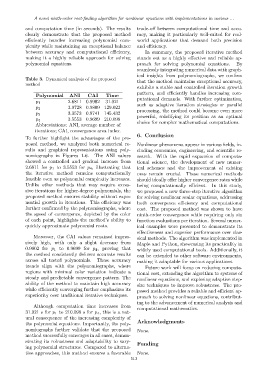
                                                              seamlessly integrating numerical data with graph-
                                                              ical insights from polynomiographs, we confirm
            Table 3. Dynamical analysis of the proposed       that the method maintains exceptional accuracy,
            method
                                                              exhibits a stable and controlled iteration growth
                                                              pattern, and efficiently handles increasing com-
                 Polynomial     ANI     CAI     Time
                                                              putational demands. With further optimization,
                 p 1           2.6811 0.9902    31.021
                                                              such as adaptive iteration strategies or parallel
                 p 2           3.0728 0.9809 129.023
                                                              processing, the method could become even more
                 p 3           3.3573 0.9741 145.432
                                                              powerful, solidifying its position as an optimal
                 p 4           3.5553 0.9699 210.098
                                                              choice for complex mathematical computations.
                 Abbreviations: ANI, average number of
                 iterations; CAI, convergence area index.
                                                              6. Conclusion
            To further highlight the advantages of the pro-
            posed method, we analyzed both numerical re-      Nonlinear phenomena appear in various fields, in-
            sults and graphical representations using poly-   cluding economics, engineering, and scientific re-
            nomiographs in Figures 1-6.    The ANI values     search. With the rapid expansion of computa-
            showed a controlled and gradual increase from     tional science, the development of new numer-
            2.6811 for p 1 to 3.5553 for p 4 , illustrating that  ical schemes and the improvement of existing
            the iterative method remains computationally      ones remain crucial. These numerical methods
            feasible even as polynomial complexity increases.  should ideally offer higher convergence rates while
            Unlike other methods that may require exces-      being computationally efficient.  In this study,
            sive iterations for higher-degree polynomials, the  we proposed a new three-step iterative algorithm
            proposed method ensures stability without expo-   for solving nonlinear scalar equations, addressing
            nential growth in iterations. This efficiency was  both convergence efficiency and computational
            further confirmed by the polynomiographs, where   cost. The proposed method was shown to have
            the speed of convergence, depicted by the color   ninth-order convergence while requiring only six
            of each point, highlights the method’s ability to  function evaluations per iteration. Several numer-
            quickly approximate polynomial roots.             ical examples were presented to demonstrate its
                                                              effectiveness and superior performance over clas-
                Moreover, the CAI values remained impres-     sical methods. The algorithm was implemented in
            sively high, with only a slight decrease from     Maple and Python, showcasing its practicality in
            0.9902 for p 1 to 0.9699 for p 4 , proving that   widely used computational tools. Additionally, it
            the method consistently delivers accurate results  can be extended to other software environments,
            across all tested polynomials.  These accuracy    making it adaptable for various applications.
            trends align with the polynomiographs, where          Future work will focus on reducing computa-
            regions with minimal color variation indicate a   tional cost, extending the algorithm to systems of
            steady and predictable convergence pattern. The   nonlinear equations, and exploring adaptive step-
            ability of the method to maintain high accuracy   size techniques to improve robustness. The pro-
            while efficiently converging further emphasizes its  posed method provides a reliable and efficient ap-
            superiority over traditional iterative techniques.  proach to solving nonlinear equations, contribut-
                                                              ing to the advancement of numerical analysis and
                Although computation time increases from      computational mathematics.
            31.021 s for p 1 to 210.098 s for p 4 , this is a nat-
            ural consequence of the increasing complexity of
                                                              Acknowledgments
            the polynomial equations. Importantly, the poly-
            nomiographs further validate that the proposed    None.
            method successfully converges in all cases, demon-
            strating its robustness and adaptability to vary-
                                                              Funding
            ing polynomial structures. Compared to alterna-
            tive approaches, this method ensures a favorable  None.
                                                           513

