


Page 139 - IJOCTA-15-3
P. 139
A novel ninth-order root-finding algorithm for nonlinear equations with implementations in various ...
            5. Polynomiography via the proposed               whileimdo
                method                                        z n + 1) = I(z n )
                                                               (
                                                              if|z n + 1) − z n | < then
                                                                  (
            The aim of this section is to represent poly-     break
            nomiographs generated using our proposed          i = i + 1
            method as outlined in Equation (9).    A poly-    colorz 0 bymeansofcolormap
            nomiograph is an image produced through the
            process of polynomiography, a term coined by
            Kalantri in 2005. It is defined as “the art and       In iterative algorithms, a stopping criterion
            science of visualization in approximation of the  is crucial for determining whether the process has
            zeros of complex polynomials, via fractal and     reached convergence or divergence. This criterion,
            non-fractal images created using the mathemati-   known as a convergence test, evaluates the algo-
            cal convergence properties of iteration functions.”  rithm’s progress in finding a solution. The typical
            The concept of a “fractal,” introduced by Benoit  form of a convergence test is
            Mandelbrot, describes a geometric shape in which
            each part has the same statistical properties as the               |z i+1 − z i | < ε        (18)
            whole. Although both polynomiographs and frac-        where z i+1 and z i are successive points in the
            tals can be created using various numerical algo-  iteration, and ε > 0 is a predefined accuracy
            rithms, they differ significantly in their structural  threshold. The convergence test (z i+1 , z i , ε) in-
            scale. A “polynomiographer” can systematically    dicates TRUE if the method converges to a root
            adjust the structure and pattern by applying dif-  and FALSE otherwise. In this study, we used this
            ferent numerical algorithms to various complex    convergence test Equation (18). The color varia-
            polynomials.   Generally, polynomiographs and     tions in the polynomiographs represent the num-
            fractals belong to different categories of graphi-  ber of iterations needed to approximate the root
            cal objects.                                      within the specified accuracy ε. By modifying the
                To create polynomiographs over the complex    parameter m, which limits the maximum number
            plane C, we begin by defining a rectangular re-   of iterations, it is possible to generate numerous
            gion R with dimensions [−2, 2]×[−2, 2], setting a  visually appealing polynomiographs. The explo-
            precision threshold of ε = 10 −3 , and an iteration  ration of polynomiography and its artistic impli-
            limit of m = 15. Each point z 0 within this region  cations is covered in references. 45–47
            undergoes an iterative process, and the point cor-    Here, we present some examples of the fol-
            responding to z 0 is colored based on how closely  lowing complex polynomials using our developed
            the truncated orbit converges to a root or fails to  algorithms and compare them with the poly-
            converge. The image resolution depends on the     nomiographs obtained by using other well-known
            discretization of the rectangle R. For example, a  two-step iterative methods:
                                                                                   2
                                                                              3
            2000 × 2000 grid results in a high-resolution im-     (i) p 1 (z) = z − z − z − 1,  Area[−2, 2]
                                                                                   3
                                                                              4
                                                                                        2
            age. The colors in polynomiographs are typically     (ii) p 2 (z) = z − z − z − z − 1, Area [-2, 2]
                                                                              5
                                                                                       3
                                                                                           2
                                                                                   4
            linked to the number of iterations required to ap-   (iii) p 3 (z) = z − z − z − z − z − 1, Area [-2,
            proximate the zeros of the complex polynomial            2]
                                                                                               2
                                                                                  5
                                                                              6
                                                                                           3
                                                                                       4
            to a specified accuracy using a chosen numerical     (iv) p 4 (z) = z −z −z −z −z −z −1, Area
            algorithm. The fundamental algorithm for gener-          [-2, 2]
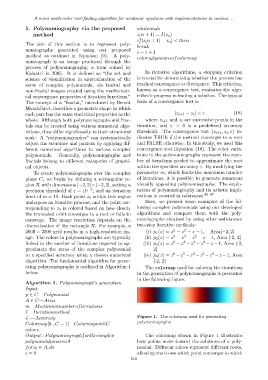
            ating polynomiographs is outlined in Algorithm 1      The colormap used for coloring the iterations
            below.                                            in the generation of polynomiographs is presented
                                                              in the following figure.
            Algorithm 1. Polynomiograph’s generation
            Input:
            p ∈ C––Polynomial
            A ∈ C––Area
            m––Maximumnumberofiterations
            I––Iterationmethod
            ∈ ––Accuracy                                      Figure 1. The colormap used for generating
                                                              polynomiographs
            Colormap[0...C − 1]––ColormapwithC
            colors.
            Output : Polynomiographforthecomplex                  The colormap shown in Figure 1 illustrates
            polynomialpinareaA                                how points move toward the solutions of a poly-
            forz 0 ∈ A, do                                    nomial. Different colors represent different roots,
            i = 0                                             allowing one to see which point converges to which
                                                           511

