


Page 140 - IJOCTA-15-3
P. 140
Srinivasarao Thota et al. / IJOCTA, Vol.15, No.3, pp.503-516 (2025)
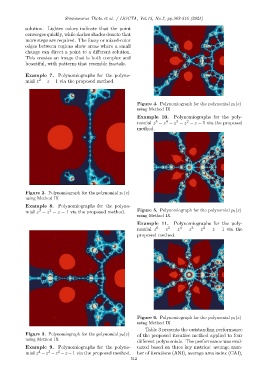
            solution. Lighter colors indicate that the point
            converges quickly, while darker shades denote that
            more steps are required. The fuzzy or mixed-color
            edges between regions show areas where a small
            change can direct a point to a different solution.
            This creates an image that is both complex and
            beautiful, with patterns that resemble fractals.

            Example 7. Polynomiographs for the polyno-
                  2
            mial z − z − 1 via the proposed method.


                                                              Figure 4. Polynomiograph for the polynomial p 3 (z)
                                                              using Method IX
                                                              Example 10.     Polynomiographs for the poly-
                                                                           4
                                                                      5
                                                                               3
                                                                                    2
                                                              nomial z − z − z − z − z − 1 via the proposed
                                                              method.


            Figure 2. Polynomiograph for the polynomial p 1 (z)
            using Method IX
            Example 8. Polynomiographs for the polyno-
                  3
                       2
            mial z − z − z − 1 via the proposed method.       Figure 5. Polynomiograph for the polynomial p 3 (z)
                                                              using Method IX
                                                              Example 11.     Polynomiographs for the poly-
                                                                                 4
                                                                            5
                                                                                      3
                                                                       6
                                                                                           2
                                                              nomial z − z − z − z − z − z − 1 via the
                                                              proposed method.


                                                              Figure 6. Polynomiograph for the polynomial p 4 (z)
                                                              using Method IX
                                                                  Table 3 presents the outstanding performance
            Figure 3. Polynomiograph for the polynomial p 2 (z)  of the proposed iterative method applied to four
            using Method IX
                                                              different polynomials. The performance was eval-
            Example 9. Polynomiographs for the polyno-        uated based on three key metrics: average num-
                      3
                           2
                  4
            mial z −z −z −z −1 via the proposed method.       ber of iterations (ANI), average area index (CAI),
                                                           512

