


Page 136 - IJOCTA-15-3
P. 136
Srinivasarao Thota et al. / IJOCTA, Vol.15, No.3, pp.503-516 (2025)
            Table 1. Summary of convergence

                     Analysis type         Result
                                                                   n
                     Local convergence     Ninth-order convergence (e ) confirmed via Taylor expansion and
                                                                   9
                                           error analysis
                     Semi-local convergence  The method is robust under smoothness conditions and has a large
                                           basin of attraction
                     Practical implications  Faster convergence than the Newton–Raphson; better stability for
                                           distant initial guesses


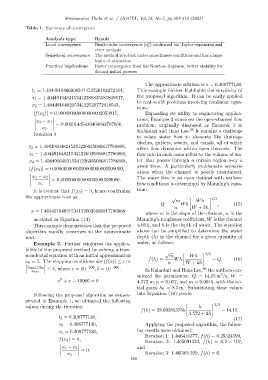
                                                                  The approximate solution is x = 6.308777130.
               t 1 = 1.4044916466908547473726183272184,       This example further highlights the simplicity of
               s 1 = 1.4044916482153412286835185849637,       the proposed algorithm. It can be easily applied
                                                              to real-world problems involving nonlinear equa-
               x 2 = 1.40449164821534122520772018543,
                                                              tions.
                |f(x 2 )| = 0.000000000000000002053915,           Expanding its utility to engineering applica-
                                                              tions, Example 3 examines the open-channel flow

                 x 2 − x 1
                          = 0.00101435436464643787660.      problem, originally discussed as Example 3 in

                    x 2                                                              38
                                                              Kalantari and Hans Lee.   It remains a challenge
                Iteration 3
                                                              to relate water flow to elements like drainage
                                                              ditches, gutters, sewers, and canals, all of which
              t 2 = 1.404491648215341226035086817786868,
                                                              affect flow dynamics within open channels. The
              s 3 = 1.404491648215341226035086817786868,      flow rate in such cases refers to the volume of wa-
              x 4 = 1.404491648215341226035086817786868,      ter that passes through a certain region over a
                                                              given time. A particularly problematic scenario
              |f(x 3 )| = 0.0000000000000000000000000000,
                                                              arises when the channel is poorly maintained.

               x 3 − x 2                                    The water flow in an open channel with uniform
                        = 0.000000000000000000589086.
                                                            flow conditions is determined by Manning’s equa-
                  x 3
                It is evident that f(x 3 ) = 0, hence confirming  tion:
            the approximate root as:                                         √                2/3
                                                                               m        Wh
                                                                        Q =      Wh               ,      (15)
                                                                              n       W + 2h
               x = 1.404491648215341226035086817786868
                                                                  where m is the slope of the channel, n is the
                as stated in Equation (14).                   Manning’s roughness coefficient, W is the channel
                This example demonstrates that the proposed   width, and h is the depth of water. The equation
            algorithm rapidly converges to the approximate    above can be simplified to determine the water
            root.                                             depth (h) in the channel for a given quantity of
                Example 2. Further reinforces the applica-    water, as follows:
            bility of the proposed method by solving a tran-
                                                                          √                2/3
            scendental equation with an initial approximation               m        Wh
                                                                   f(h) =     Wh               − Q.      (16)
            x 0 = 5. The stopping conditions are |f(x)| ≤ ε or              n      W + 2h

                      ≤ δ, where ε = 10   , δ = 10   .                                    38
             x n+1 −x n              −200       −600
                                                                 In Kalantari and Hans Lee,  the authors con-
               x n+1
                                                                                                   3
                                                              sidered the parameters: Q = 14.15 m /s, W =
                            5
                           x + x − 10000 = 0                  4.572 m, n = 0.017, and m = 0.0015, with the ini-
                                                              tial guess h 0 = 8.5 m. Substituting these values
                Following the proposed algorithm as demon-    into Equation (16) yields:
            strated in Example 1, we obtained the following
                                                                                               2/3
            values during the iteration:                                                 h
                                                                f(h) = 28.69285373h                − 14.15.
                                                                                     4.572 + 2h
                           t 2 = 6.308777130,
                                                                                                         (17)
                           s 2 = 6.308777130,                     Applying the proposed algorithm, the follow-
                           x 3 = 6.308777130,                 ing results were obtained:
                                                                  Iteration 1: 1.446410377, f(h) = 0.25324599,
                           f(x 3 ) = 0,
                                                                  Iteration 2: 1.465091222, f(h) = 0.2 × 10⁷,

                            x 3 − x 2                       and
                                     = 0.

                               x 3
                                                                Iteration 3: 1.465091220, f(h) = 0.
                                                           508

