


Page 155 - IJOCTA-15-4
P. 155
Green innovation efficiency measurement and its influencing factors in specialized and new enterprises
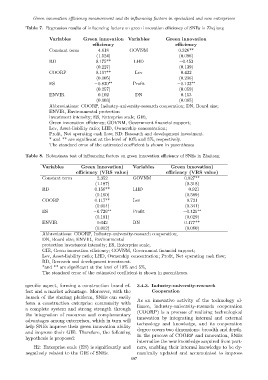
            Table 7. Regression results of influencing factors on green innovation efficiency of SNEs in Zhejiang

                       Variables      Green innovation Variables           Green innovation
                                          efficiency                           efficiency
                       Constant term         4.618         GOVNM                0.326**
                                            (1.524)                              (0.096)
                       RD                   0.175**         LHD                  −0.453
                                            (0.227)                              (0.139)
                       COORP                0.107**          Lev                 0.432
                                            (0.005)                              (0.236)
                       ES                  −0.830 ∗∗        Profit              −0.133 ∗∗
                                            (0.257)                              (0.059)
                       ENVIR                 0.102           DN                  0.153
                                            (0.003)                              (0.085)
                       Abbreviations: COORP, Industry-university-research cooperation; DN, Board size;
                       ENVIR, Environmental protection
                       investment intensity; ES, Enterprise scale; GIE,
                       Green innovation efficiency; GOVNM, Government financial support;
                       Lev, Asset-liability ratio; LHD, Ownership concentration;
                       Profit, Net operating cash flow; RD: Research and development investment.
                       * and ** are significant at the level of 10% and 5%, respectively.
                       The standard error of the estimated coefficient is shown in parentheses

            Table 8. Robustness test of influencing factors on green innovation efficiency of SNEs in Zhejiang

                    Variables        Green innovation)      Variables        Green innovation)
                                   efficiency (VRS value)                  efficiency (VRS value)
                    Constant term           2.352           GOVNM                  0.827**
                                           (1.187)                                 (0.318)
                    RD                     0.156**          LHD                    −0.921
                                           (0.160)                                 (0.589)
                    COORP                  0.117**          Lev                     0.721
                                           (0.004)                                 (0.341)
                    ES                    −0.726 ∗∗         Profit                −0.125 ∗∗
                                           (0.181)                                 (0.029)
                    ENVIR                   0.042           DN                     0.177**
                                           (0.002)                                 (0.060)
                    Abbreviations: COORP, Industry-university-research cooperation;
                    DN, Board size; ENVIR, Environmental
                    protection investment intensity; ES, Enterprise scale;
                    GIE, Green innovation efficiency; GOVNM, Government financial support;
                    Lev, Asset-liability ratio; LHD, Ownership concentration; Profit, Net operating cash flow;
                    RD, Research and development investment.
                    *and ** are significant at the level of 10% and 5%,
                    The standard error of the estimated coefficient is shown in parentheses.

            specific aspect, forming a construction brand ef-  3.4.3. Industry-university-research
            fect and a market advantage. Moreover, with the         Cooperation
            launch of the sharing platform, SNEs can easily
            form a construction enterprise community with     As an innovative activity of the technology al-
            a complete system and strong strength through     liance, industry-university-research cooperation
            the integration of resources and complementary    (COORP) is a process of realizing technological
                                                              innovation by integrating internal and external
            advantages among enterprises, which in turn will
                                                              technology and knowledge, and its cooperation
            help SNEs improve their green innovation ability
                                                              degree covers two dimensions: breadth and depth.
            and improve their GIE. Therefore, the following
                                                              In the process of COORP and innovation, SNEs
            hypothesis is proposed:
                                                              internalize the new knowledge acquired from part-
                H2: Enterprise scale (ES) is significantly and  ners, enabling their internal knowledge to be dy-
            negatively related to the GIE of SNEs.            namically updated and accumulated to improve
                                                           697

