


Page 157 - IJOCTA-15-4
P. 157
Green innovation efficiency measurement and its influencing factors in specialized and new enterprises
            through the capital structure, and the pressure   4.2.2. Correlation analysis
            of high debt often forces firms to prioritize short-
            term gain projects and reduce long-term invest-   Table 7 presents the regression results of the
            ments in green technology. 47  Board size has an  model, indicating the effects of R&D investment,
                                                              ES, COORP, ENVIR, and GOVNM on GIE of
            inverted U-shaped relationship with innovation
                                                              SNEs in Zhejiang. The five hypotheses raised pre-
            efficiency, while moderate size enhances decision-
                                                              viously were analyzed accordingly:
            making expertise, but overexpansion leads to
            higher coordination costs and lower decision-
                                                                  (i) The GIE is significantly positively cor-
            making efficiency. In contrast, net operating cash
                                                                     related with R&D investment. Overall,
            flow may have an indirect effect by affecting the
                                                                     the standardized regression coefficient for
            overall investment capacity of the firm. Together,
                                                                     R&D investment measured by R&D capi-
            these variables constitute the key governance af-
                                                                     tal stock is 0.175 and passes the 5% signif-
            fecting the GIE of SNEs. The specific definitions
                                                                     icance test, indicating that R&D invest-
            of the variables are presented in Table 4.
                                                                     ment promotes the improvement of GIE
                                                                     in SNEs. Therefore, H1 is verified. Un-
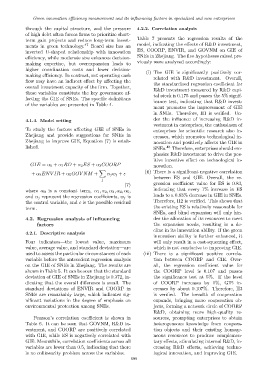
            4.1.4. Model setting                                     der the influence of increasing R&D in-
                                                                     vestment in enterprises, the enthusiasm of
            To study the factors affecting GIE of SNEs in            enterprises for scientific research also in-
            Zhejiang and provide suggestions for SNEs in             creases, which promotes technological in-
            Zhejiang to improve GIE, Equation (7) is estab-          novation and positively affects the GIE in
            lished.                                                  SNEs. 48  Therefore, enterprises should em-
                                                                     phasize R&D investment to drive the pos-
                                                                     itive incentive effect on technological in-
               GIE = α 0 + α 1 RD + α 2 ES + α 3 COORP               novation.
                                             X                   (ii) There is a significant negative correlation
               + α 4 ENV IR + α 5 GOV NM +       α j w j + ε
                                                                     between ES and GIE. Overall, the re-
                                              j
                                                        (7)          gression coefficient value for ES is 0.83,
            where α 0 is a constant term, α 1 , α 2 , α 3 , α 4 , α 5 ,  indicating that every 1% increase in ES
            and α j represent the regression coefficients, w j is    leads to a 0.83% decrease in GIE in SNEs.
            the control variable, and ε is the possible residual     Therefore, H2 is verified. This shows that
            term.                                                    the existing ES is relatively reasonable for
                                                                     SNEs, and blind expansion will only hin-
            4.2. Regression analysis of influencing                  der the allocation of its resources to meet
                 factors                                             the expansion needs, resulting in a de-
                                                                     cline in its innovation ability. If the green
            4.2.1. Descriptive analysis
                                                                     innovation ability is further enhanced, it
            Four indicators—the lowest value, maximum                will only result in a cost-squeezing effect,
            value, average value, and standard deviation—are         which is not conducive to improving GIE.
            used to assess the particular circumstances of each  (iii) There is a significant positive correla-
            variable before the antecedent regression analysis       tion between COORP and GIE. Over-
            on the GIE of SNEs in Zhejiang. The results are          all, the regression coefficient value for
            shown in Table 5. It can be seen that the standard       the COORP level is 0.107 and passes
            deviation of GIE of SNEs in Zhejiang is 0.372, in-       the significance test at 5%. If the level
            dicating that the overall difference is small. The       of COORP increases by 1%, GIE in-
            standard deviations of ENVIR and COORP in                creases by about 0.107%. Therefore, H3
            SNEs are remarkably large, which indicates sig-          is verified. The breadth of cooperation
            nificant variations in the degree of emphasis on         expands, bringing more cooperation ob-
            environmental protection among SNEs.                     jects, forming a network circle of COORP
                                                                     R&D, obtaining more high-quality re-
                Pearson’s correlation coefficient is shown in        sources, prompting enterprises to obtain
            Table 6. It can be seen that GOVNM, R&D in-              heterogeneous knowledge from coopera-
            vestment, and COORP are positively correlated            tion objects and their existing homoge-
            with GIE, while ES is negatively correlated with         neous resources to produce complemen-
            GIE. Meanwhile, correlation coefficients across all      tary effects, stimulating internal R&D, in-
            variables are lower than 0.5, indicating that there      creasing R&D efforts, achieving techno-
            is no collinearity problem across the variables.         logical innovation, and improving GIE.
                                                           699

