


Page 167 - IJOCTA-15-4
P. 167
African vultures optimization-based hybrid neural network–proportional-integral-derivative controller...
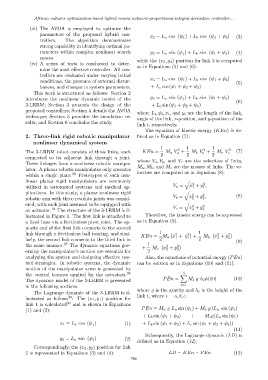
              (iii) The AVOA is employed to optimize the
                   parameters of the proposed hybrid con-           x 2 = L a cos (ψ 1 ) + L b cos (ψ 1 + ψ 2 )  (3)
                   trollers.  The algorithm demonstrates
                   strong capability in identifying optimal pa-
                   rameters within complex nonlinear search         y 2 = L a sin (ψ ) + L b sin (ψ 1 + ψ 2 )  (4)
                                                                                  1
                   spaces.
                                                              while the (x 3 , y 3 ) position for link 3 is computed
              (iv) A series of tests is conducted to deter-
                                                              as in Equations (5) and (6):
                   mine the most effective controller. All con-
                   trollers are evaluated under varying initial
                                                                    x 3 = L a cos (ψ 1 ) + L b cos (ψ 1 + ψ 2 )
                   conditions, the presence of external distur-                                           (5)
                   bances, and changes in system parameters.        + L c cos (ψ 1 + ψ 2 + ψ 3 )
                This work is structured as follows: Section 2
            introduces the nonlinear dynamic model of the           y 3 = L a sin (ψ ) + L b sin (ψ 1 + ψ 2 )  (6)
                                                                                  1
            3-LRRM; Section 3 presents the design of the            + L c sin (ψ 1 + ψ 2 + ψ 3 )
            proposed controllers; Section 4 details the AVOA
                                                              where L i , ψ i , x i , and y i are the length of the link,
            technique; Section 5 provides the simulation re-
                                                              angle of the link, x-position, and y-position of the
            sults; and Section 6 concludes the study.
                                                              link i, respectively.
                                                                  The equation of kinetic energy (KEn) is de-
            2. Three-link rigid robotic manipulator           fined as in Equation (7):
                nonlinear dynamical system
                                                                        1       2   1      2   1       2
            The 3-LRRM robot consists of three links, each      KEn =   2  M a V +  2  M b V +  2  M c V c  (7)
                                                                                a
                                                                                           b
            connected to its adjacent link through a joint.
            These linkages form a nonlinear robotic manipu-   where V a , V b , and V c are the velocities of links,
                                                              M a , M b , and M c are the masses of links. The ve-
            lator. A planar robotic manipulator only operates
            within a single plane. 36  Prototypes of such non-  locities are computed as in Equation (8).
            linear planar rigid manipulators are commonly                          q  2    2
            utilized in automated systems and medical ap-                     V a =   ˙ x + ˙y ,
                                                                                           1
                                                                                      1
            plications. In this study, a planar nonlinear rigid                    q  2    2
                                                                              V b =  ˙ x + ˙y ,           (8)
            robotic arm with three revolute joints was consid-                        2    2
            ered, with each joint assumed to be equipped with                 V c =  q  ˙ x + ˙y 2
                                                                                      2
            an actuator. 18  The structure of the 3-LRRM is il-                       3    3
            lustrated in Figure 1. The first link is attached to  Therefore, the kinetic energy can be expressed
            a fixed base via a frictionless pivot joint. The op-  as in Equation (9).
            posite end of the first link connects to the second
                                                                        1
            link through a frictionless ball bearing, and simi-  KEn = M a ˙x + ˙y  2    +  1   ˙ x + ˙y 2
                                                                                                  2
                                                                               2
            larly, the second link connects to the third link in        2      1    1    2  M b   2   2   (9)
            the same manner. 37  The dynamic equations gov-     +  1      ˙ x + ˙y 2
                                                                           2
            erning the manipulator’s motion are essential for      2  M c  3    3
            analyzing the system and designing effective con-     Also, the equations of potential energy (PEn)
            trol strategies. In robotic systems, the dynamic  can be written as in Equations (10) and (11).
            motion of the manipulator arms is generated by
                                                                                  3
            the control torques applied by the actuators. 38                     X
            The dynamic model of the 3-LRRM is presented                 PEn =       M i g h i ψ(10)     (10)
            in the following sections.                                           i=1
                                                              where g is the gravity and h i is the height of the
                The Lagrange dynamic of the 3-LRRM is il-
                               39
            lustrated as follows : The (x 1 , y 1 ) position for  link i, where i = a, b, c.
            link 1 is calculated 39  and is shown in Equations
            (1) and (2):                                        PEn = M a g L a sin (ψ 1 ) + M b g (L a sin (ψ 1 )
                                                                + L b sin (ψ 1 + ψ 2 )  +   M c g(L a sin (ψ 1 )
                            x 1 = L a cos (ψ )          (1)     + L b sin (ψ 1 + ψ 2 ) + L c sin (ψ 1 + ψ 2 + ψ 3 ))
                                          1
                                                                                                         (11)
                                                                  Subsequently, the Lagrange dynamic (LD) is
                            y 1 = L a sin (ψ 1 )        (2)
                                                              defined as in Equation (12);
                Correspondingly, the (x 2 , y 2 ) position for link
            2 is represented in Equations (3) and (4):                      LD = KEn − PEn               (12)
                                                           709

