Page 170 - IJOCTA-15-4
P. 170

Oleiwi et al. / IJOCTA, Vol.15, No.4, pp.706-727 (2025)
                                                              as 1/N, is not adjusted dynamically. Instead, it
                                    1          N              must be tuned offline alongside the NN parame-
                G(s)     = K p + K i  + K d s          (39)
                     PID                                      ters prior to deployment.
                                    S        S + N
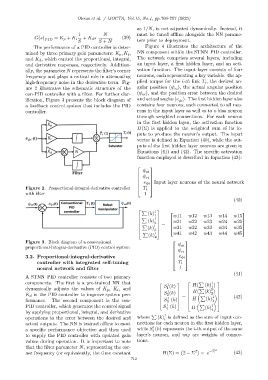
                The performance of a PID controller is deter-     Figure 4 illustrates the architecture of the
            mined by three primary gain parameters: K p , K i ,  NN component within the STNN–PID controller.
            and K d , which control the proportional, integral,  The network comprises several layers, including
            and derivative responses, respectively. Addition-  an input layer, a first hidden layer, and an acti-
            ally, the parameter N represents the filter’s corner  vation function. The input layer consists of four
            frequency and plays a critical role in attenuating  neurons, each representing a key variable: the ap-
            high-frequency noise in the derivative term. Fig-  plied torque for the i-th link T i , the desired an-
            ure 2 illustrates the schematic structure of the  gular position (ψ ), the actual angular position
                                                                               ri
            con-PID controller with a filter. For further clar-  (ψ ai ), and the position error between the desired
            ification, Figure 3 presents the block diagram of  and actual angles (e ). The first hidden layer also
                                                                                ψi
            a feedback control system that includes the PID   contains four neurons, each connected to all neu-
            controller.                                       rons in the input layer as well as to a bias neuron
                                                              through weighted connections. For each neuron
                                                              in the first hidden layer, the activation function
                                                              H(Σ) is applied to the weighted sum of its in-
                                                              puts to produce the neuron’s output. The input
                                                              vector is defined in Equation (40), while the out-
                                                              puts of the first hidden layer neurons are given in
                                                              Equations (41) and (42). The specific activation
                                                              function employed is described in Equation (43):

                                                                   
                                                                ψ ai
                                                                ψ
                                                                   
                                                                 ri 
                                                                 e ψi Input layer neurons of the neural network
                                                                   
                                                                   
            Figure 2. Proportional-integral-derivative controller    T i  
            with filter                                          1
                                                                                                         (40)
                                                                      
                                                                P     1
                                                                   (k)                                      
                                                                      1       w11    w12   w13    w14    w15
                                                              P      1  
                                                                      2
                                                                  (k)       w21   w22   w23    w24    w25 
                                                                         =                                 
                                                               P
                                                                  (k)  1    w31   w32   w33    w34    w35 
                                                                    3 
                                                                P     1       w41    w42   w43    w44    w45
                                                                   (k)
                                                                      4
            Figure 3. Block diagram of a conventional                             
                                                                                ψ ai
            proportional-integral-derivative (PID) control system
                                                                                ψ  
                                                                                 ri 
            3.2. Proportional-integral-derivative                               e ψi  
                                                                                  
                 controller with integrated self-tuning                         T i  
                 neural network and filter                                       1
                                                                                                         (41)
            A STNN–PID controller consists of two primary
            components. The first is a pre-trained NN that                1         H( P  (k) )  
                                                                                               1
                                                                                               1
                                                                           1
            dynamically adjusts the values of K p , K i , and             S (k)       H( P (k) )
                                                                           1
                                                                                               1 
            K d in the PID controller to improve system per-              S (k)        P   2 
                                                                           2
                                                                                
                                                                        
                                                                           1     =        (k) 1       (42)
                                                                                     H
            formance.   The second component is the con-                 S (k)               3  
                                                                        
                                                                           3
                                                                                               
                                                                           1
            PID controller, which generates the control signal           S (k)        H   P (k) 1
                                                                           4
            by applying proportional, integral, and derivative                                 4
                                                                    P     1
            operations to the error between the desired and   where    (k) is defined as the sum of input con-
                                                                          i
            actual outputs. The NN is trained offline to meet  nections for each neuron in the first hidden layer,
                                                                     1
            a specific performance objective and then used    while S (k) represents the i-th output of the same
                                                                     i
            to supply the PID controller with updated gain    layer’s neuron, and wij are weights of connec-
            values during operation. It is important to note  tions.
            that the filter parameter N, representing the cor-                                   2
            ner frequency (or equivalently, the time constant            H(Σ) = 2 − Σ   2   × e −Σ      (43)
                                                           712
   165   166   167   168   169   170   171   172   173   174   175