Page 172 - IJOCTA-15-4
P. 172

Oleiwi et al. / IJOCTA, Vol.15, No.4, pp.706-727 (2025)
            assigned to each neuron, serves as the input for
            these neurons. These weights function similarly
                                                                                       4
            to the gains (K p , K i , and K d ) in con-PID con-            H(Σ) =            − 2         (54)
            trol, as shown in Equations (48)–(51).                                 (1 + e −Σ )


                                                                    P     1      1
                                                              where    (k) and S (k) are the sum of input con-
                                                                          i      i
                                                              nections for each second-layer neuron and the re-
                                                              sult of the second layer’s i − th neuron, and vij
                                                              and α i represent the weights.
                                                                  The third hidden layer consists of three neu-
                                                              rons. Each neuron in this layer receives weighted
                                                              inputs from all outputs of the second hidden layer,
                                                              in addition to its previous output and a weighted
                                                              contribution from the previous output of the out-
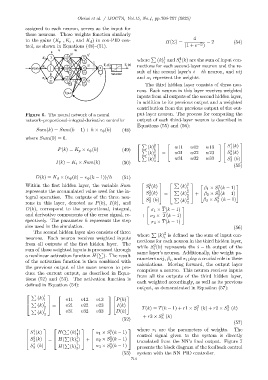
            Figure 6. The neural network of a neural          put layer neuron. The process for computing the
            network–proportional-integral-derivative controller  output of each third-layer neuron is described in
                                                              Equations (55) and (56):
                 Sum(k) = Sum(k − 1) + h × e ψ (k)     (48)

            where Sum(0) = 0.
                                                                                                           
                                                               P    2                              1
                                                                   (k)         w11    w12   w13       S (k)
                                                                                                       1
                           P(k) = K p × e ψ (k)        (49)     P    1 2                              1    
                                                                                                       2
                                                                  (k)    =    w21  w22   w23      S (k)
                                                                     2                                     
                                                                P    2                                 1
                                                                   (k)         w31    w32   w33       S (k)
                                                                                                       3
                          I(k) = K i × Sum(k)          (50)          3
                                                                                                         (55)
                 D(k) = K d × (e ψ (k) − e ψ (k − 1))/h  (51)
            Within the first hidden layer, the variable Sum       S (k)     P  (k) 2     β 1 × S (k − 1)  
                                                                   2
                                                                                                  2
                                                                   1
                                                                                    1
                                                                                                  1
            represents the accumulated value used for the in-     S (k)      P  (k)  +   β 2 × S (k − 1)  
                                                                   2
                                                                                                  2
                                                                                    2 
                                                                   2
                                                                                                  2
            tegral operation. The outputs of the three neu-       S (k)  =   P   2      β 3 × S (k − 1)
                                                                                                  2
                                                                   2
                                                                                    2
            rons in this layer, denoted as P(k), I(k), and         3             (k) 3           3
            D(k), correspond to the proportional, integral,         σ 1 × T(k − 1)  
            and derivative components of the error signal, re-  +    σ 2 × T(k − 1)  
            spectively. The parameter h represents the step         σ 3 × T(k − 1)
            size used in the simulation.                                                                 (56)
                The second hidden layer also consists of three      P     2
                                                              where    (k) is defined as the sum of input con-
            neurons. Each neuron receives weighted inputs                 i
                                                              nections for each neuron in the third hidden layer,
            from all outputs of the first hidden layer. The   while S (k) represents the i − th output of the
                                                                     2
            sum of these weighted inputs is processed through        i
                                             P                same layer’s neuron. Additionally, the weight pa-
            a nonlinear activation function H(  ). The result
                                                              rameters wij, β i , and σ i play a crucial role in these
            of the activation function is then combined with
                                                              calculations. Moving forward, the output layer
            the previous output of the same neuron to pro-
                                                              comprises a neuron. This neuron receives inputs
            duce the current output, as described in Equa-
                                                              from all the outputs of the third hidden layer,
            tions (52) and (53). The activation function is
                                                              each weighted accordingly, as well as its previous
            defined in Equation (54):
                                                              output, as demonstrated in Equation (57):
              P     1  
                  (k)                                 
                     1        v11    v12    v13      P(k)
               P
                  (k)  =    v21    v22    v23    I(k)  
                    1 
                                                                                                      2
                                                                                         2
                    2                                          T(k) = T(k − 1) + r1 × S (k) + r2 × S (k)
               P     1                                                                  1             2
                  (k)         v31    v32    v33      D(k)
                     3                                          + r3 × S (k)
                                                                         2
                                                       (52)              3
                                                                                                         (57)
               1          P     1            1          where r i are the parameters of weights.   The
              S (k)        H(   (k) )       α 1 × S (k − 1)
                1                  1              1           control signal given to the system is directly
              S (k)   =  H(               α 2 × S (k − 1)
               1           P    1            1       
                                   2
               2               (k) )  +        2          translated from the NN’s final output. Figure 7
                                                  1
                1
                                   1
              S (k)        H( P (k) )       α 3 × S (k − 1)   presents the block diagram of the feedback control
                                                  3
                3
                                   3
                                                       (53)   system with the NN–PID controller.
                                                           714
   167   168   169   170   171   172   173   174   175   176   177