


Page 176 - IJOCTA-15-4
P. 176
Oleiwi et al. / IJOCTA, Vol.15, No.4, pp.706-727 (2025)
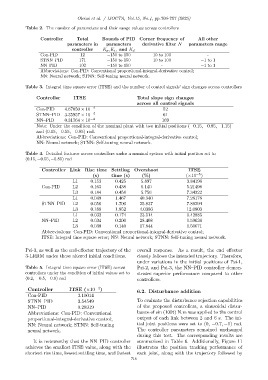
            Table 2. The number of parameters and their range values across controllers

                   Controller      Total      Bounds of PID Corner frequency of          All other
                               parameters in    parameters      derivative filter N  parameters range
                                 controller    K p , K i , and K d
                   Con-PID           12          −150 to 150         10 to 100               -
                   STNN–PID         171          −150 to 150         10 to 100            −1 to 1
                   NN–PID           102          −150 to 150             -                −1 to 1
                   Abbreviations: Con-PID: Conventional proportional-integral-derivative control;
                   NN: Neural network; STNN: Self-tuning neural network.

            Table 3. Integral time square error (ITSE) and the number of control signals’ sign changes across controllers

                 Controller       ITSE                        Total slope sign changes
                                                              across all control signals
                 Con-PID      4.67050 × 10 −4                            52
                 STNN–PID 3.35957 × 10   −4                              61
                 NN–PID       0.31764 × 10 −4                            169
                 Note: Under the condition of the nominal plant with two initial positions (−0.15, −0.85, −1.15)
                 and (0.15, −0.55, −0.85) rad.
                 Abbreviations: Con-PID: Conventional proportional-integral-derivative control;
                 NN: Neural network; STNN: Self-tuning neural network.

            Table 4. Detailed features across controllers under a nominal system with initial position set to
            (0.15, −0.55, −0.85) rad
                    Controller Link Rise time Settling Overshoot                     ITSE
                                          (s)      time (s)     (%)                 (×10 −5 )
                                 L1      0.153      0.425       5.897               3.84196
                    Con-PID      L2      0.163      0.438       6.140               5.21498
                                 L3      0.184      0.458       5.756               7.34322
                                 L1      0.049      1.467      40.940               7.26176
                    STNN–PID     L2      0.050      1.700      25.837               7.86294
                                 L3      0.188      1.852      4.0386               12.0803
                                 L1      0.032      0.174      23.514               0.42885
                    NN–PID       L2      0.034      0.200      28.408               0.59636
                                 L3      0.039      0.140      17.844               0.50671
                    Abbreviations: Con-PID: Conventional proportional-integral-derivative control;
                    ITSE: Integral time square error; NN: Neural network; STNN: Self-tuning neural network.


            Psi-3, as well as the end-effector trajectory of the  overall response. As a result, the end effector
            3-LRRM under these altered initial conditions.    closely follows the intended trajectory. Therefore,
                                                              under variations in the initial positions of Psi-1,
            Table 5. Integral time square error (ITSE) across  Psi-2, and Psi-3, the NN–PID controller demon-
            controllers under the condition of initial values set to  strates superior performance compared to other
            (0.2, −0.5, −0.8) rad                             controllers.


             Controller         ITSE (×10  −4 )
                                                              6.2. Disturbance addition
             Con-PID                3.10014
             STNN–PID               3.54549                   To evaluate the disturbance rejection capabilities
             NN–PID                 0.28919                   of the proposed controllers, a sinusoidal distur-
             Abbreviations: Con-PID: Conventional             bance of sin (100t) N.m was applied to the control
             proportional-integral-derivative control;        output of each link between 2 and 6 s. The ini-
             NN: Neural network; STNN: Self-tuning            tial joint positions were set to (0, −0.7, −1) rad.
             neural network.                                  The controller parameters remained unchanged
                                                              during this test. The corresponding results are
                It is noteworthy that the NN–PID controller   summarized in Table 6. Additionally, Figure 11
            achieves the smallest ITSE value, along with the  illustrates the position tracking performance of
            shortest rise time, lowest settling time, and fastest  each joint, along with the trajectory followed by
                                                           718

