


Page 177 - IJOCTA-15-4
P. 177
African vultures optimization-based hybrid neural network–proportional-integral-derivative controller...


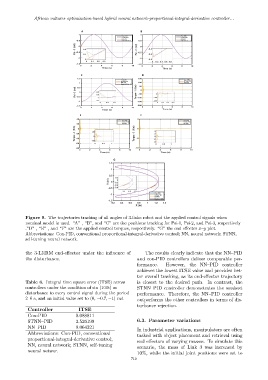
            Figure 9. The trajectories tracking of all angles of 3-links robot and the applied control signals when
            nominal model is used. “A” , “B”, and “C” are the positions tracking for Psi-1, Psi-2, and Psi-3, respectively
            .”D” , “E” , and “F” are the applied control torques, respectively. “G” the end effector x–y plot.
            Abbreviations: Con-PID, conventional proportional-integral-derivative control; NN, neural network; STNN,
            self-tuning neural network.


            the 3-LRRM end-effector under the influence of        The results clearly indicate that the NN–PID
            the disturbance.                                  and con-PID controllers deliver comparable per-
                                                              formance.    However, the NN–PID controller
                                                              achieves the lowest ITSE value and provides bet-
                                                              ter overall tracking, as its end-effector trajectory
            Table 6. Integral time square error (ITSE) across  is closest to the desired path. In contrast, the
            controllers under the condition of sin (100t) as  STNN–PID controller demonstrates the weakest
            disturbance to every control signal during the period  performance. Therefore, the NN–PID controller
            2–6 s, and an initial value set to (0, −0.7, −1) rad  outperforms the other controllers in terms of dis-
                                                              turbance rejection.
             Controller             ITSE
             Con-PID               0.088811
             STNN–PID              3.526199                   6.3. Parameter variations
             NN–PID                0.064321
                                                              In industrial applications, manipulators are often
             Abbreviations: Con-PID, conventional
                                                              tasked with object placement and retrieval using
             proportional-integral-derivative control;
                                                              end effectors of varying masses. To simulate this
             NN, neural network; STNN, self-tuning
                                                              scenario, the mass of Link 3 was increased by
             neural networ.
                                                              10%, while the initial joint positions were set to
                                                           719

