


Page 174 - IJOCTA-15-4
P. 174
Oleiwi et al. / IJOCTA, Vol.15, No.4, pp.706-727 (2025)
links. Accordingly, a separate trajectory analy-
( sis was performed for each link in every test sce-
Equation (64) if Po3 ≥ randPo3
Po(i + 1) = nario. This objective ensures effective error re-
Equation (66) if Po3 < randPo3
duction and facilitates accurate and rapid con-
(69) vergence to the desired trajectories. The classical
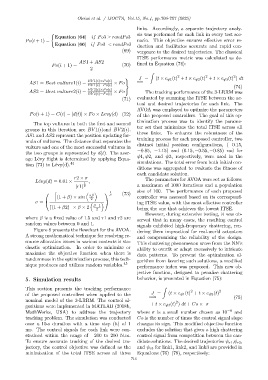
ITSE performance metric was calculated as de-
AS1 + AS2
Po(i + 1) = (70) fined in Equation (74):
2
Z
2
2
2
J = (t × e ψ1 (t) + t × e ψ2 (t) + t × e ψ3 (t) ) dt
BV 1(i)×Po(i) min
AS1 = Best vulture1(i) − × Fo
BV 1(i)−Po(i) (74)
AS2 = Best vulture2(i) − BV 2(i)×Po(i) × Fo The tracking performance of the 3-LRRM was
BV 2(i)−Po(i)
(71) evaluated by summing the ITSE between the ac-
tual and desired trajectories for each link. The
AVOA was employed to optimize the parameters
Po(i + 1) = C(i) − |d(t)| × Fo × Levy(d) (72) of the proposed controllers. The goal of this op-
timization process was to identify the parame-
The top vultures in both the first and second
groups in this iteration are BV 1(i)and BV 2(i). ter set that minimizes the total ITSE across all
three links. To enhance the robustness of the
AS1 and AS2 represent the position updating for-
training process for each proposed controller, two
mula of vultures. The distance that separates the
distinct initial position configurations, (−0.15,
vulture and one of the most successful vultures in
−0.85, −1.15) and (0.15, −0.55, −0.85) rad for
the two groups is represented by d(t). The aver-
ψ1, ψ2, and ψ3, respectively, were used in the
age L´evy flight is determined by applying Equa-
tion (73) to L´evy(d). 44 simulations. The total error from both initial con-
ditions was aggregated to evaluate the fitness of
each candidate solution.
r2 × σ
L´evy(d) = 0.01 × 1 , The parameters for AVOA were set as follows:
|r1| β a maximum of 1000 iterations and a population
1 size of 100. The performance of each proposed
l
πβ β (73)
(1 + β) × sin controller was assessed based on its correspond-
2
σ = ing ITSE value, with the most effective controller
β−1
⌈(1 + β2) × β × 2
2 being the one that achieves the lowest ITSE.
However, during extensive testing, it was ob-
where β is a fixed value of 1.5 and r1 and r2 are
served that in many cases, the resulting control
random values between 0 and 1.
signals exhibited high-frequency chattering, ren-
Figure 8 presents the flowchart for the AVOA.
dering them impractical for real-world actuators
A strong mathematical technique for resolving re-
and compromising the reliability of the design.
source allocation issues in various contexts is sto-
This chattering phenomenon arose from the NN’s
chastic optimization. In order to minimize or
ability to overfit or adapt excessively to intricate
maximize the objective function when there is data patterns. To prevent the optimization al-
randomness in the optimization process, this tech- gorithm from favoring such solutions, a modified
nique produces and utilizes random variables. 45 performance index was proposed. This new ob-
jective function, designed to penalize chattering
5. Simulation results behavior, is presented in Equation (75):
This section presents the tracking performance Z 2 2
of the proposed controllers when applied to the J = (t × e ψ1 (t) + t × e ψ2 (t)
min (75)
nominal model of the 3-LRRM. The control al- 2
+ t × e ψ3 (t) ) dt + Co × σ
gorithms were implemented in MATLAB (2018b,
MathWorks, USA) to address the trajectory where σ is a small number chosen as 10 −8 and
tracking problem. The simulation was conducted Co is the number of times the control signal slope
over a 10-s duration with a time step (h) of 1 changes its sign. This modified objective function
ms. The control signals for each link were con- excludes the solution that gives a high chattering
strained within the range of −200 to 200 N.m. control signal from competition between the can-
To ensure accurate tracking of the desired tra- didate solutions. The desired trajectories ψ r1 ,ψ r2 ,
jectory, the control objective was defined as the and ψ r3 for link1, link2, and link3 are provided in
minimization of the total ITSE across all three Equations (76)–(78), respectively:
716

