


Page 169 - IJOCTA-15-4
P. 169
African vultures optimization-based hybrid neural network–proportional-integral-derivative controller...
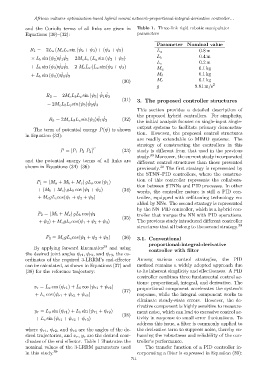
            and the Coriolis terms of all links are given in  Table 1. Three-link rigid robotic manipulator
            Equations (30)–(32):                              parameters

                                                                       Parameter Nominal value
              R 1 = −2L a (M c L c sin (ψ 2 + ψ 3 ) + (ψ 2 + ψ 3 )     L a                0.8 m
                           ˙ ˙
               × L b sin (ψ 2 )ψ 1 ψ 2 − 2M c L c (L a sin (ψ 2 + ψ 3 )  L b              0.4 m
                                                                       L c                0.2 m
                           ˙ ˙
               + L b sin (ψ 3 )ψ 2 ψ 3 − 2 M c L c (L a sin(ψ 2 + ψ 3 )
                                                                       M a               0.1 kg
                            ˙ ˙                                        M b               0.1 kg
               + L b sin (ψ 3 ))ψ 1 ψ 3
                                                       (30)            M c               0.1 kg
                                                                                                2
                                                                       g                9.81 m/s
                                              ˙ ˙
                      R 2 = −2M c L b L c sin (ψ 3 ) ψ 1 ψ 3
                                                       (31)   3. The proposed controller structures
                                         ˙ ˙
                      − 2M c L b L c sin(ψ 3 )ψ 2 ψ 3
                                                              This section provides a detailed description of
                                                              the proposed hybrid controllers. For simplicity,
                                             ˙ ˙
                       R 3 = 2M c L b L c sin(ψ 3 )ψ 1 ψ 2  (32)
                                                              the initial analysis focuses on single-input single-
                                                              output systems to facilitate primary demonstra-
                The term of potential energy P(ψ) is shown
                                                              tion. However, the proposed control structures
            in Equation (33):
                                                              are readily extendable to MIMO systems. The
                                                              strategy of constructing the controllers in this
                            P = [P 1 P 2 P 3 ] T       (33)   study is different from that used in the previous
                                                              study. 39  Moreover, the current study incorporated
            and the potential energy terms of all links are
                                                              different control structures than those presented
            shown in Equations (34)–(36):                               39
                                                              previously.  The first strategy is represented by
                                                              the STNN–PID controllers, where the construc-
                                                              tion of this controller represents the collabora-
                 P 1 = (M a + M b + M c ) gL a cos (ψ 1 )
                                                              tion between STNNs and PID processes. In other
                  + (M b + M c ) gL b cos (ψ 1 + ψ 2 )  (34)  words, the controller nature is still a PID con-
                  + M c gL c cos(ψ 1 + ψ 2 + ψ 3 )            troller, equipped with self-tuning technology en-
                                                              abled by NNs. The second strategy is represented
                                                              by the NN–PID controller, which is a hybrid con-
                  P 2 = (M b + M c ) gL b cos(ψ 1             troller that merges the NN with PID operations.
                                                       (35)
                  + ψ 2 ) + M c gL c cos(ψ 1 + ψ 2 + ψ 3 )    The previous study introduced different controller
                                                              structures that all belong to the second strategy. 39

                     P 3 = M c gL c cos(ψ 1 + ψ 2 + ψ 3 )  (36)  3.1. Conventional
                                                                   proportional-integral-derivative
                By applying forward kinematics 39  and using       controller with filter
            the desired joint angles ψ r1 , ψ r2 , and ψ r3 , the co-
            ordinates of the required 3-LRRM’s end-effector   Among various control strategies,     the PID
            can be calculated, as shown in Equations (37) and  method remains a widely adopted approach due
            (38) for the reference trajectory:                to its inherent simplicity and effectiveness. A PID
                                                              controller combines three fundamental control ac-
                                                              tions: proportional, integral, and derivative. The
                x r = L a cos (ψ r1 ) + L b cos (ψ r1 + ψ r2 )  proportional component accelerates the system’s
                                                       (37)
                 + L c cos (ψ r1 + ψ r2 + ψ r3 )              response, while the integral component works to
                                                              eliminate steady-state errors. However, the de-
                                                              rivative component is highly sensitive to measure-
                y r = L a sin (ψ r1 ) + L b sin (ψ r1 + ψ r2 )  ment noise, which can lead to excessive control ac-
                                                       (38)
                 + L c sin (ψ r1 + ψ r2 + ψ r3 )              tivity in response to small error fluctuations. To
                                                              address this issue, a filter is commonly applied to
            where ψ r1 , ψ r2 , and ψ r3 are the angles of the de-  the derivative term to suppress noise, thereby en-
            sired trajectories, and x r , y r are the desired coor-  hancing the robustness and reliability of the con-
            dinates of the end effector. Table 1 illustrates the  troller's performance.
            nominal values of the 3-LRRM parameters used          The transfer function of a PID controller in-
            in this study. 39                                 corporating a filter is expressed in Equation (39):
                                                           711

