


Page 188 - IJOCTA-15-4
P. 188
E.M. Shaban / IJOCTA, Vol.15, No.4, pp.728-737 (2025)
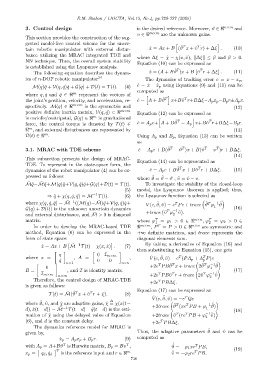
3. Control design is the desired reference. Moreover, ϑ ∈ ℜ n×m and
υ ∈ ℜ m×m are the unknown gains.
This section provides the construction of the sug-
gested model-free control scheme for the uncer- h T i
ˆ T
tain robotic manipulator with external distur- ˙ x = Ax + B (ϑ x + ˆυ r) + ∆ξ . (10)
bance utilizing the MRAC integrated TDE and where ∆ξ = ˆχ − χ(x, ˙x), ∥∆ξ∥ ≤ β and β > 0.
NN technique. Then, the overall system stability Equation (10) can be expressed as
is established using the Lyapunov analysis. T
ˆ T
The following equation describes the dynam- ˙ x = (A + Bϑ )x + B ˆυ r + ∆ξ . (11)
ics of n-DOF robotic manipulator 34 The dynamics of tracking error e = x − x p ,
M(q)¨q + V(q, ˙q) ˙q + G(q) + D(t) = T (t). (4) ˙ e = ˙x − ˙x p using Equations (9) and (11) can be
computed as
where q, ˙q and ¨q ∈ ℜ m represent the vectors of h i
ˆ T
T
the joint’s position, velocity, and acceleration, re- ˙ e = A + Bϑ x+Bˆυ r+B∆ξ−A p x p −B p r±A p x.
spectively. M(q) ∈ ℜ m×m is the symmetric and (12)
positive definite inertia matrix, V(q, ˙q) ∈ ℜ m×m Equation (12) can be expressed as
is coriolis/centripetal, G(q) ∈ ℜ m is gravitational h i
T
ˆ T
force, the control torque is denoted by T (t) ∈ ˙ e = A p e+ A + Bϑ − A p x+Bˆυ r+B∆ξ−B p r.
m
ℜ , and external disturbances are represented by (13)
m
D(t) ∈ ℜ . Using A p and B p , Equation (13) can be written
as
T
T
ˆ T
T
3.1. MRAC with TDE scheme ˙ e = A p e + B(ϑ − ϑ )x + B(ˆυ − υ )r + B∆ξ.
(14)
This subsection presents the design of MRAC- Equation (14) can be represented as
TDE. To represent in the state-space form, the
T
˜ T
dynamics of the robot manipulator (4) can be ex- ˙ e = A p e + Bϑ x + B˜υ r + B∆ξ. (15)
pressed as follows: ˜ ˆ
where ϑ = ϑ − ϑ , ˜υ = ˆυ − υ.
¯
¯
M¨q−M¨q+M(q)¨q+V(q, ˙q) ˙q+G(q)+D(t) = T (t). To investigate the stability of the closed-loop
(5) model, the Lyapunov theorem is applied; thus,
¯ −1
⇒ ¨q + χ(q, ˙q, ¨q) = M T (t). (6) the Lyapunov function is selected as
¯
¯ −1
where χ(q, ˙q, ¨q) = M ((M(q)−M)¨q+V(q, ˙q) ˙q+ V (e, ϑ, ˜υ) = e Pe + trace ϑ φ −1 ˜
˜
T
˜T
ϑ
G(q) + D(t)) is the unknown uncertain dynamics T −1 1 (16)
¯
and external disturbance, and M > 0 is diagonal +trace ˜υ φ 2 ˜ υ .
matrix. where φ T = φ 1 > 0 ∈ ℜ n×n , φ T = φ 2 > 0 ∈
1 2
In order to develop the MRAC-based TDE ℜ m×m , P T = P > 0 ∈ ℜ n×n are symmetric and
method, Equation (6) can be expressed in the +ve definite matrices, and trace represents the
form of state space: diagonal elements sum.
¯ −1
By taking a derivative of Equation (16) and
˙ x = Ax + B M T (t) − χ(x, ˙x) . (7)
then substituting to Equation (15), one gets
q 0 I m×m
˜
˙
T
where x = , A = , V (e, ϑ, ˜υ) = e (PA p + A P)e
T
˙ q 0 0 p
n×1 n×n −1 ˙
ˆ
˜T
˜T
T
+2e PBϑ x + trace 2ϑ φ ϑ
0 1
B = , and I is identity matrix. (17)
I m×m T T T −1 ˙
n×m +2e PB˜υ r + trace 2˜υ φ 2 ˆ υ
Therefore, the control design of MRAC-TDE T
+2e PB∆ξ.
is given as follows:
Equation (17) can be expressed as
¯ ˆ T
T
T (t) = M(ϑ x + ˆυ r + ˆχ). (8)
˙
˜
T
V (e, ϑ, ˜υ) = −e Qe
∆
ˆ
where ϑ, ˆυ, and ˆχ are adaptive gains, ˆχ = χ(x(t− ˜T T −1 ˙
ˆ
¯ −1
d), ˙x(t − d)) = M T (t − d) − ¨q(t − d) is the esti- +2trace ϑ (xe PB + φ 1 ϑ)
(18)
T
T
mation of ˆχ using the delayed value of Equation +2trace ˜υ (re PB + φ −1 ˙ ˆ υ)
2
(6), and d is the constant delay. +2e PB∆ξ.
T
The dynamics reference model for MRAC is
ˆ
given by, Thus, the adaptive parameters ϑ and ˆυ can be
˙ x p = A p x p + B p r. (9) computed as
˙
T
T
ˆ
T
with A p = A+Bϑ is Hurwitz matrix, B p = Bυ , ϑ = −φ 1 xe PB,
˙
T m T (19)
x p = q d , ˙q d is the reference input and r ∈ ℜ ˆ υ = −φ 2 re PB.
730

