


Page 190 - IJOCTA-15-4
P. 190
E.M. Shaban / IJOCTA, Vol.15, No.4, pp.728-737 (2025)
˜
Remark 1 To successfully implement the de- ˜ υ and W are all bounded according to Barbalat’s
signed controller, we can effectively work with the Lemma 36 . Taking the integration of Equation
obtainable joint position, even without known ve- (38) from 0 to ∞, we have
locity and acceleration. We can confidently esti-
∞
mate velocity and acceleration by employing the R T
Q e(σ) e(σ)dσ
robust observer, ensuring optimal performance. 0
The following are the estimates of ˙q and ¨q 35 R ∞ ˙ ˜ ˜ (39)
≤ − V (e(σ), ϑ(σ), ˜υ(σ), W(σ))dσ
0
dz 0 = z 1 + φ 0 ,
dt = V 0 − V ∞ < ∞.
dz 1 = z 2 + φ 1 , (33)
dt
dz 2 = φ 2 .
The bounded function V is non-increasing with
dt bounded initial value V 0 ; therefore, it may be
˙
¨
T
where z 0 = ˆq, z 1 = ˆq, z 2 = ˆq, α > 0 and stated that lim t→∞ R 0 t e(σ) e(σ)dσ and ˙e is
2−j
φ j (e) = α|e| 3 sgn(e) when j = 0, 1, 2. bounded. Following this, the tracking error
asymptotically converges to zero.
3.3. Stability investigation
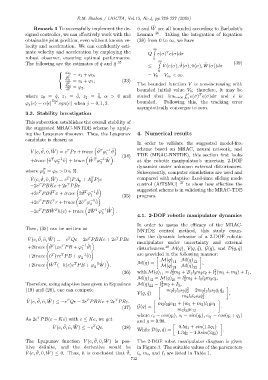
This subsection establishes the overall stability of
the suggested MRAC-NNTDE scheme by apply-
ing the Lyapunov theorem. Thus, the Lyapunov 4. Numerical results
candidate is chosen as
In order to validate the suggested model-free
scheme based on MRAC, neural network, and
˜
˜
T
˜T
ϑ
V (e, ϑ, ˜υ, W) = e Pe + trace ϑ φ −1 ˜
1
(34) TDE (MRAC-NNTDE), this section first looks
T
˜ T
W .
+trace ˜υ φ −1 ˜ υ + trace W φ −1 ˜ at the robotic manipulator’s uncertain 2-DOF
3
2
dynamics under unknown external disturbances.
T
where φ = φ 3 > 0 ∈ ℜ.
3 Subsequently, computer simulations are used and
˙
˜
˜
T
T
V (e, ϑ, ˜υ, W) = e (PA p + A P)e compared with adaptive fixed-time sliding mode
p
37
T
T
−2e PBKe + 2e PBε control (AfTSMC) to show how effective the
−1 ˙ suggested scheme is in validating the MRAC-TDE
ˆ
˜T
˜T
T
+2e PBϑ x + trace 2ϑ φ ϑ
1 (35) program.
T
T
T
+2e PB˜υ r + trace 2˜υ φ −1 ˙
ˆ υ
2
−1 ˙
ˆ
˜ T
˜ T
T
−2e PBW h(e) + trace 2W φ W .
3
4.1. 2-DOF robotic manipulator dynamics
In order to assess the efficacy of the MRAC-
Then, (35) can be written as
NNTDE control method, this study exam-
˜
˙
˜
T
T
T
V (e, ϑ, ˜υ, W) = −e Qe − 2e PBKe + 2e PBε ines the dynamic behavior of a 2-DOF robotic
−1 ˙ manipulator under uncertainty and external
ˆ
˜T
T
+2trace ϑ (xe PB + φ 1 ϑ) disturbances. 38 M(q), V(q, ˙q), G(q), and D(q, ˙q)
T
T
+2trace ˜υ (re PB + φ −1 ˙ ˆ υ) are provided in the following manner:
2
−1 ˙ M(q) = M(q) 11 M(q) 12 ,
ˆ
T
˜ T
+2trace W (−h(e)e PB + φ W) . M(q) M(q)
3 21 22
2
2
(36) with M(q) 11 = l m 2 + 2l 1 l 2 m 2 c 2 + l (m 1 + m 2 ) + I 1 ,
1
2
2
M(q) = M(q) = l m 2 + l 1 l 2 m 2 c 2 ,
12 21 2
2
Therefore, using adaptive laws given in Equations M(q) = l m 2 + I 2 ,
2
2
22
(19) and (28), one can compute −m 2 l 1 l 2 s 2 ˙q − 2m 2 l 1 l 2 s 2 ˙q ˙q
V(q, ˙q) = 2 2 1 2 ,
m 2 l 1 l 2 s 2 ˙q 2
T
T
˙
˜
T
˜
V (e, ϑ, ˜υ, W) ≤ −e Qe − 2e PBKe + 2e PBε. m 2 l 2 gc 12 + (m 1 + m 2 )l 1 gc 1
(37) G(q) = .
m 2 l 2 gc 12
where c i = cos(q i ), s i = sin(q i ), c ij = cos(q i + q j )
T
As 2e PB(ε − Ke) with ε ≤ Ke, we get
and g = 0.98.
˙
T
˜
˜
V (e, ϑ, ˜υ, W) ≤ −e Qe. (38) 0.5 ˙q 1 + sin(1.5q 1 )
While D(q, ˙q) = .
1.3 ˙q 2 − 1.8sin(2q 2 )
˜
˜
The Lyapunov function V (e, ϑ, ˜υ, W) is pos- The 2-DOF robot manipulator diagram is given
itive definite, and the derivative would be in Figure 3. The suitable values of the parameters
˜
˜
˜
˙
V (e, ϑ, ˜υ, W) ≤ 0. Thus, it is concluded that ϑ, l i , m i , and I i are listed in Table 1.
732

