


Page 107 - IJPS-1-1
P. 107
Kuang-Chi Chang

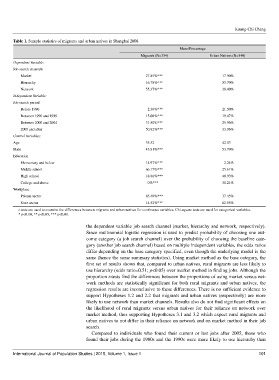
       Table 1. Sample statistics of migrants and urban natives in Shanghai 2008
                                                                              Mean/Percentage
                                                             Migrants (N=334)              Urban Natives (N=540)
       Dependent Variable:
       Job search channels
          Market                                               27.85%***                        17.90%
          Hierarchy                                            16.78%***                        53.70%
          Network                                              55.37%***                        28.40%
       Independent Variable:
       Job search period
          Before 1990                                           2.30%***                        21.50%
          Between 1990 and 1999                                15.08%***                        19.47%
          Between 2000 and 2004                                31.80%***                        25.96%
          2005 and after                                       50.82%***                        33.06%
       Control Variables:
       Age                                                     35.52                            42.03
       Male                                                    45.81%***                        53.70%
       Education
          Elementary and below                                 14.97%***                         2.24%
          Middle school                                        66.17%***                        25.61%
          High school                                          18.86%***                        40.93%
          College and above                                     0%***                           31.21%
       Workplace
          Private sector                                       85.48%***                        37.45%
          State sector                                         14.52%***                        62.55%
         t-tests are used to examine the differences between migrants and urban natives for continuous variables. Chi-square tests are used for categorical variables.
         * p<0.10, ** p<0.05, *** p<0.01.

                                      the dependent variable job search channel (market, hierarchy and network, respectively).
                                      Since multinomial logistic regression is used to predict probability of choosing one out-
                                      come category (a job search channel) over the probability of choosing the baseline cate-
                                      gory (another job search channel) based on multiple independent variables, the odds ratios
                                      differ depending on the base category specified, even though the underlying model is the
                                      same (hence the same summary statistics). Using market method as the base category, the
                                      first set of results shows that, compared to urban natives, rural migrants are less likely to
                                      use hierarchy (odds ratio=0.51; p<0.05) over market method in finding jobs. Although the
                                      proportion t-tests find the differences between the proportions of using market versus net-
                                      work methods are statistically significant for both rural migrants and urban natives, the
                                      regression results are inconclusive to these differences. There is no sufficient evidence to
                                      support Hypotheses 1.2 and 2.2 that migrants and urban natives (respectively) are more
                                      likely to use network than market channels. Results also do not find significant effects on
                                      the likelihood of rural  migrants versus urban natives for their reliance on network over
                                      market method, thus supporting Hypotheses 3.1 and 3.2 which expect rural migrants and
                                      urban natives to not differ in their reliance on network and on market method in their job
                                      search.
                                        Compared to individuals who found their current or last jobs after 2005, those  who
                                      found their jobs during the 1980s and the 1990s were more likely to use hierarchy than


       International Journal of Population Studies | 2015, Volume 1, Issue 1                                   101

