


Page 108 - IJPS-1-1
P. 108
Finding a job in urban China: A comparative analysis of migrants and natives

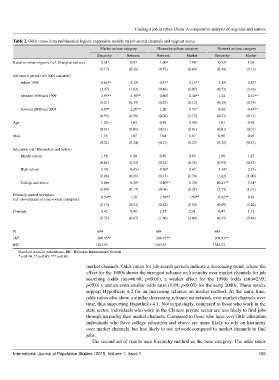
       Table 2. Odds ratios from multinomial logistic regression models on job search channels and migrant status
                                            Market as base category   Hierarchy as base category   Network as base category
                                          Hierarchy    Network      Network      Market      Hierarchy    Market
       Rural-to-urban migrants (ref: Shanghai natives)   0.51*   0.97   1.90*     1.96*       0.53*        1.03
                                            (0.17)      (0.29)       (0.52)      (0.64)       (0.14)      (0.31)
       Job search period (ref: 2005 and after)
          before 1990                       6.68**       3.15*       0.47*        0.15**      2.12*        0.32*
                                            (3.27)      (1.62)       (0.16)      (0.07)       (0.72)      (0.16)
          between 1990 and 1999             2.95**       2.38**      0.807        0.34**      1.24         0.42**
                                            (1.01)      (0.79)       (0.23)      (0.12)       (0.35)      (0.14)
          between 2000 and 2004             1.89*        2.26**      1.20         0.53*       0.84         0.44**
                                            (0.53)      (0.58)       (0.30)      (0.15)       (0.21)      (0.11)
       Age                                  1.02+        1.02        0.99         0.98+       1.01         0.98
                                            (0.01)      (0.01)       (0.01)      (0.01)       (0.01)      (0.01)
       Male                                 1.03         1.07        1.04         0.97        0.96         0.93
                                            (0.24)      (0.24)       (0.21)      (0.23)       (0.20)      (0.21)
       Education (ref: Elementary and below)
          Middle school                     1.58         0.80        0.50         0.63        1.98         1.25
                                            (0.88)      (0.33)       (0.24)      (0.35)       (0.93)      (0.52)
          High school                       1.50         0.45+       0.30*        0.67        3.34*        2.23+
                                            (0.86)      (0.20)       (0.15)      (0.38)       (1.62)      (1.00)
          College and above                 3.06+        0.30*       0.10**       0.33+      10.21**       3.34*
                                            (1.99)      (0.17)       (0.06)      (0.21)       (5.75)      (1.91)
       Privately-owned workplace            0.50**       1.20        2.39**       1.99**      0.42**       0.83
       (ref: Government or state-owned enterprise)
                                            (0.13)      (0.31)       (0.52)      (0.50)       (0.09)      (0.22)
       Constant                             0.42         0.90        2.15         2.41        0.47         1.12
                                            (0.35)      (0.67)       (1.60)      (2.04)       (0.35)      (0.84)

       N                                   684                      684                      684
         2
       chi                                 208.93**                 208.93**                 208.93**
       BIC                                1383.53                  1383.53                  1383.53
         Standard errors in parentheses. BIC: Bayesian Information Criterion
         * p<0.10, ** p<0.05, *** p<0.01.

                                      market channels. Odds ratios for job search periods indicate a decreasing trend, where the
                                      effect for the 1980s shows the strongest reliance on hierarchy over market channels for job
                                      searching  (odds  ratio=6.68;  p<0.01),  a  weaker  effect  for  the  1990s  (odds  ratio=2.95;
                                      p<0.01), and an even smaller odds ratio (1.89; p<0.05) for the early 2000s. These results
                                      support Hypothesis 4.2 for an increasing reliance on market method. At the same time,
                                      odds ratios also show a similar decreasing reliance on network over market channels over
                                      time, thus supporting Hypothesis 4.1. Not surprisingly, compared to those who work in the
                                      state sector, individuals who work in the Chinese private sector are less likely to find jobs
                                      through hierarchy than market channels. Compared to those who have very little education,
                                      individuals who have college education  and above  are  more likely to rely on hierarchy
                                      over market channels, but less likely to use network compared to market channels to find
                                      jobs.
                                        The second set of results uses hierarchy method as the base category. The odds ratios

       International Journal of Population Studies | 2015, Volume 1, Issue 1                                   102

