


Page 28 - IJPS-1-1
P. 28
Diagnosis and control of hypertension in the elderly populations of Japan and the United States

                                      experienced hypertension were then asked if they  used  medication for the condition.
                                      Overall hypertension is indicated by either having measured hypertension or using medi-
                                      cation.  Table 1  presents  descriptive  measures on the sample and for  the  hypertension
                                      measures.
                                        By utilizing measured hypertension and diagnosed hypertension, we are able to divide
                                      the total population into four hypertension categories: healthy, undiagnosed hypertension,
                                      controlled hypertension, and uncontrolled hypertension. Healthy was defined as not having
                                      measured hypertension and  reporting that  one has never been diagnosed  with or expe-
                                      rienced hypertension. Undiagnosed hypertension was defined as having measured hyper-
                                      tension but reporting that one has never been diagnosed with or experienced hypertension.
                                      Uncontrolled hypertension  was defined  as  having  measured hypertension and  reporting
                                      hypertension. Controlled hypertension was defined as having been diagnosed with or ex-
                                      periencing hypertension and having  measured systolic blood pressure of less than 140
                                      mmHg and diastolic blood pressure of less than 90 mmHg.

                                      2.3 Statistical Methods
                                      All analyses were weighted and conducted on Statistical Analysis System (SAS) 9·2 (SAS
                                      Institute Inc. Cary, NC). To account for missing data on measured blood pressure, an ad-
                                      justed weight  was created for  NUJLSOA by  multiplying the normalized  weight of the
                                      sample which accounted for the lack of survey response and differential selection by age
                                      by the inverse of the predicted probability that each participant would have a blood pres-
                                      sure measurement. The predicted probability was based on age, sex, and level of education.
                                      It was used  in  all analyses. For the HRS, sample weights which accounted for survey
                                      non-response, nonresponse to the blood pressure  measurement, and initial proability of
                                      selection were provided by the survey and were used for all analyses.

                                      3. Results
                                      3.1 Descriptive Results

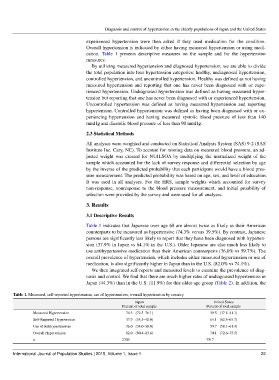
                                      Table 1 indicates that Japanese over age 68 are almost twice as likely as their American
                                      counterparts to be measured as hypertensive (74.3% versus 39.5%). By contrast, Japanese
                                      persons are significantly less likely to report that they have been diagnosed with hyperten-
                                      sion (37.9% in Japan vs 64.1% in the U.S.). Older Japanese are also much less likely to
                                      use antihypertensive medication than their American counterparts (36.0% vs 59.7%). The
                                      overall prevalence of hypertension, which includes either measured hypertension or use of
                                      medication, is also significantly higher in Japan than in the U.S. (82.0% vs 74.1%).
                                        We then integrated self-reports and measured levels to examine the prevalence of diag-
                                      nosis and control. We find that there are much higher rates of undiagnosed hypertension in
                                      Japan (44.3%) than in the U.S. (11.9%) for this older age group (Table 2). In addition, the

       Table 1. Measured, self-reported hypertension, use of hypertensives, overall hypertension by country
                                                           Japan                            United States
                                                     Percent of total sample             Percent of total sample
               Measured Hypertension                   74.3   (72.5–76.1)                  39.5   (37.8–41.1)
               Self-Reported Hypertension              37.9   (35.3–40.0)                  64.1   (62.5–65.7)
               Use of Antihypertensives                36.0   (34.0–38.0)                  59.7   (58.1–61.4)
               Overall Hypertension                    82.0   (80.4–83.6)                  74.1   (72.6–75.5)
               n                                     2309                                3517

       International Journal of Population Studies | 2015, Volume 1, Issue 1                                    22

