


Page 30 - IJPS-1-1
P. 30
Diagnosis and control of hypertension in the elderly populations of Japan and the United States


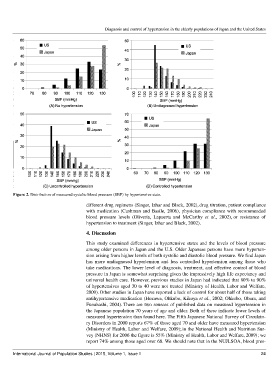
       Figure 2. Distribution of measured systolic blood pressure (SBP) by hypertensive state.


                                      different drug regimens (Singer, Izhar and Black, 2002), drug titration, patient compliance
                                      with medication (Cushman and Basile, 2006), physician compliance with recommended

                                      blood  pressure levels (Oliveria, Lapuerta and  McCarthy  et al., 2002), or resistance of
                                      hypertension to treatment (Singer, Izhar and Black, 2002).

                                      4. Discussion

                                      This study examined differences in hypertensive states and the levels of blood pressure
                                      among older persons in Japan and the U.S. Older Japanese persons have more hyperten-
                                      sion arising from higher levels of both systolic and diastolic blood pressure. We find Japan
                                      has  more undiagnosed hypertension  and less controlled hypertension among those who
                                      take medications. The lower level of diagnosis, treatment, and effective control of blood
                                      pressure in Japan is somewhat surprising given the impressively high life expectancy and
                                      universal health care. However, previous studies in Japan had indicated that 80% to 90%
                                      of hypertensives aged 30 to 40 were not treated (Ministry of Health, Labor and Welfare,

                                      2009). Other studies in Japan have reported a lack of control for about half of those taking
                                      antihypertensive medication (Hozawa, Ohkubo, Kikuya et al., 2002; Ohkubo, Obara, and

                                      Funahashi, 2004). There are two sources of published data on measured hypertension in
                                      the Japanese population 70 years of age and older. Both of these indicate lower levels of
                                      measured hypertension than found here. The Fifth Japanese National Survey of Circulato-
                                      ry Disorders in 2000 reports 67% of those aged 70 and older have measured hypertension

                                      (Ministry of Health, Labor and Welfare, 2009); in the National Health and Nutrition Sur-

                                      vey (NHNS) for 2006 the figure is 55% (Ministry of Health, Labor and Welfare, 2009); we
                                      report 74% among those aged over 68. We should note that in the NUJLSOA, blood pres-

       International Journal of Population Studies | 2015, Volume 1, Issue 1                                    24

