


Page 29 - IJPS-1-1
P. 29
Yasuhiko Saito, Shieva Davarian, Atsuhiko Takahashi, Edward Schneider and Eileen M. Crimmins

       Table 2. Hypertensive states: healthy, undiagnosed, controlled, uncontrolled by country
                                                           Japan                            United States

                                                          Percent                             Percent
                   Healthy                             17.8   (16.1–19.3)                  24.0   (22.6–25.4)
                   Undiagnosed                         44.3   (42.2–46.4)                  11.9   (10.8–12.9)
                   Controlled                          8.0   (6.8–9.1)                     36.5   (34.9–38.1)
                   Uncontrolled                        29.9   (28.1–31.9)                  27.6   (26.1–29.5)
                   Total                              100.0                               100.0
                   n                                 2309                                3517

                                      Japanese also experience much lower levels of controlled hypertension (8.0%) compared
                                      to the U.S. (36.5%). However, uncontrolled blood pressure is not significantly different in
                                      the U.S. (27.6%) and Japan (29.9%). The proportion healthy (without any hypertension) is
                                      somewhat higher in the U.S. (24.0% vs 17.8%).
                                      3.2 Blood Pressure Values in the U.S. and Japan

                                      In order to increase  our understanding of the reasons for the  large differences  reported
                                      above, we examined the distribution of systolic and diastolic blood pressure levels in the
                                      total samples (Figure 1) and systolic pressure among those who are classified as having no
                                      hypertension, undiagnosed hypertension, controlled, and those with uncontrolled hyper-
                                      tension who are taking medications (Figure 2). This detail indicates the sources of the dif-
                                      ferences in hypertension as well as providing some idea of how much blood pressure
                                      needs to be changed to achieve control. The modes of the distributions of systolic and di-
                                      astolic blood pressure for the Japanese sample are 20 and 10 percentage points higher than
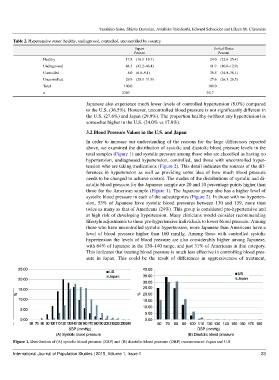
                                      those for the American sample (Figure 1). The Japanese group also has a higher level of
                                      systolic blood pressure in each of the subcategories (Figure 2). In those with no hyperten-
                                      sion, 53%  of Japanese have systolic blood pressures between 130 and 139,  more than
                                      twice as many as that of Americans (24%). This group is considered pre-hypertensive and
                                      at high risk of developing hypertension. Many clinicians would consider recommending
                                      lifestyle adjustments to these pre-hypertensive individuals to lower blood pressure. Among
                                      those who have uncontrolled systolic hypertension, more Japanese than Americans have a
                                      level of blood pressure higher than 160  mmHg. Among those with controlled systolic
                                      hypertension the levels of blood pressure are also considerably higher among Japanese,
                                      with 64% of Japanese in the 130–140 range, and just 31% of Americans in that category.
                                      This indicates that treating blood pressure is much less effective in controlling blood pres-
                                      sure in Japan. This could be the  result of differences in  aggressiveness of treatment,


       Figure 1. Distribution of (A) systolic blood pressure (SBP) and (B) diastolic blood pressure (DBP) measurement: Japan and U.S.
       International Journal of Population Studies | 2015, Volume 1, Issue 1                                    23

