


Page 38 - IJPS-1-1
P. 38
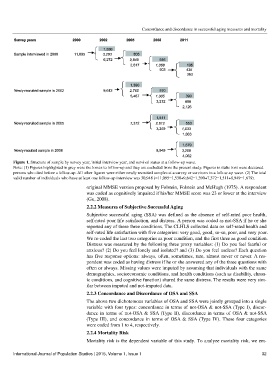
Concordance and discordance in successful aging measures and mortality


       Figure 1. Structure of sample by survey year, initial interview year, and survival status at a follow-up wave.
       Note: (1) Figures highlighted in grey were the losses to follow-up and they are excluded from the present study. Figures in italic font were deceased
       persons who died before a follow-up. All other figures were either newly recruited samples at a survey or survivors in a follow-up wave. (2) The total
       valid number of individuals who have at least one follow-up interview was 30,948 (=11,095−1,530+9,642−1,390+7,372−1,511+8,949−1,679).

                                      original MMSE version proposed by Folstein, Folstein and McHugh (1975). A respondent
                                      was coded as cognitively impaired if his/her MMSE score was 23 or lower at the interview
                                      (Gu, 2008).
                                      2.2.2 Measures of Subjective Successful Aging
                                      Subjective successful aging (SSA) was defined as the absence of self-rated poor health,
                                      self-rated poor life satisfaction, and distress. A person was coded as not-SSA if he or she
                                      reported any of these three conditions. The CLHLS collected data on self-rated health and
                                      self-rated life satisfaction with five categories: very good, good, so-so, poor, and very poor.
                                      We re-coded the last two categories as poor condition, and the first three as good condition.
                                      Distress was measured by the following three proxy variables: (1) Do you feel fearful or
                                      anxious? (2) Do you feel lonely and isolated? and (3) Do you feel useless? Each question
                                      has five response options: always, often, sometimes, rare, almost never or never. A res-
                                      pondent was coded as having distress if he or she answered any of the three questions with
                                      often or always. Missing values were imputed by assuming that individuals with the same
                                      demographics, socioeconomic conditions, and health conditions (such as disability, chron-
                                      ic conditions, and cognitive function) shared the same distress. The results were very sim-
                                      ilar between imputed and not-imputed data.
                                      2.2.3 Concordance and Discordance of OSA and SSA
                                      The above two dichotomous variables of OSA and SSA were jointly grouped into a single
                                      variable with four types: concordance in terms of not-OSA & not-SSA (Type I), discor-
                                      dance in terms of not-OSA & SSA (Type II), discordance in terms of OSA & not-SSA
                                      (Type III), and concordance in terms of OSA & SSA (Type IV). These four categories
                                      were coded from 1 to 4, respectively.

                                      2.2.4 Mortality Risk
                                      Mortality risk is the dependent variable of this study. To analyze mortality risk, we em-

       International Journal of Population Studies | 2015, Volume 1, Issue 1                                    32

