


Page 42 - IJPS-1-1
P. 42
Concordance and discordance in successful aging measures and mortality

           1.00                                              1.00


         Survival probability  0.75  0.50  Not-OSA & Not-SSA (Type I)  Survival probability  0.75  0.50  Not-OSA & Not-SSA (Type I)


                      Not-OSA & SSA (Type II)
                                                                    OSA & Not-SSA (Type III)
           0.25       OSA & Not-SSA (Type III)               0.25   Not-OSA & SSA (Type II)
                      OSA & SSA (Type IV)
                                                                    OSA & SSA (Type IV)
           0.00                                              0.00
            0         500      1000      1500       2000       0        500       1000      1500      2000
                       Analysis time (since previous wave)              Analysis time (days since previous wave)

                           (A) Ages 65−79                                                                   (B) Ages 80−89

           1.00                                              1.00

         Survival probability  0.75  0.50                  Survival probability  0.75  0.50


                  Not-OSA & SSA (Type II)
           0.25   Not-OSA & Not-SSA (Type I)                 0.25  Not-OSA & Not-SSA (Type I)
                                                                   Not-OSA & SSA (Type II)
                  OSA & Not-SSA (Type III)
                  OSA & SSA (Type IV)                              OSA & Not-SSA (Type III)
           0.00                                              0.00  OSA & SSA (Type IV)
            0         500      1000      1500       2000       0        500       1000      1500      2000
                      Analysis time (days since previous wave)           Analysis time (since previous wave)

                             (C) Ages 90−99                                                                    (D) Ages 100+
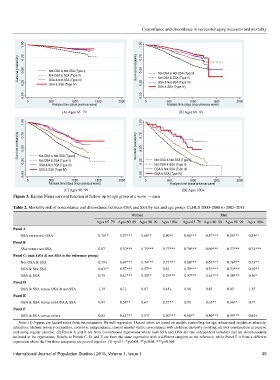
       Figure 3. Kaplan-Meier survival function at follow-up by age group at a wave — men

       Table 2. Mortality risk of concordance and discordance between OSA and SSA by sex and age group, CLHLS 2000–2008 to 2002–2011
                                                         Women                                 Men
                                          Ages 65–79  Ages 80–89  Ages 90–99  Ages 100+   Ages 65–79  Ages 80–89  Ages 90–99  Ages 100+
       Panel A
          OSA versus not-OSA               0.71**   0.57***   0.60**   0.50**   0.68***   0.57***   0.58***   0.54**
       Panel B
          SSA versus not-SSA               0.87     0.70***   0.75***   0.77***   0.70***   0.69***   0.77***   0.74***
       Panel C: (not-OSA & not-SSA is the reference group)
          Not-OSA & SSA                    0.79+    0.69***   0.74***   0.77***   0.60***   0.67***   0.76***   0.73**
          OSA & Not-SSA                    0.63**   0.57***   0.57**   0.63    0.59***   0.53***   0.53***   0.36**
          OSA & SSA                        0.75     0.41***   0.50**   0.29***   0.57***   0.44***   0.50***   0.56*
       Panel D
          OSA & SSA versus OSA & not-SSA   1.19     0.71     0.87     0.45+    0.96      0.83     0.95     1.55
       Panel E
          OSA & SSA versus not-OSA & SSA   0.94     0.58**   0.67     0.37**   0.95      0.65**   0.66**   0.77
       Panel F
          OSA & SSA versus others          0.83     0.44***   0.53*   0.30***   0.68**   0.50***   0.55***   0.62+
         Note: (1) Figures are hazard ratios from the parametric Weibull regression. Hazard ratios are based on models controlling for age, urban-rural residence, ethnicity,
       education, lifetime primary occupation, economic independence, current marital status, co-residence with children, currently smoking, alcohol consumption at present,
       and doing regular exercise. (2) Panels A and B are from conventional regressions where both SSA and OSA are two independent variables and are simultaneously
       included in the regressions. Results in Panels C, D, and E are from the same regression with a different category as the reference, while Panel F is from a different
       regression where the first three categories are pooled together. (3) +p<0.1, *p<0.05, **p<0.01, ***p<0.001.

       International Journal of Population Studies | 2015, Volume 1, Issue 1                                    36

