


Page 116 - IJPS-2-2
P. 116
Utilization of maternal and child health care services in North and South India: does spousal violence matter?

       olence respectively. These four states were combined as North Indian states and were referred as the
       North states henceforth. The second group of states consisted of Maharashtra, Andhra Pradesh, and
       Tamil Nadu with the level of spousal violence at 33.4%, 36.8%, and 44.1% respectively. These three
       states were grouped as South Indian states and were referred as the South states (IIPS and Macro
       International, 2007). The selection of states was based on the higher incidence of spousal violence in
       order to avoid the variations in the prevalence of spousal violence and to compare its effects on the
       utilization of MCH care services.
         The sample for this study was young  married women, aged 15–30 years, with at  least one
       live birth in the five years prior to the survey. The sample size was 4,837 for the North and 3,304 for
       the South. According to national survey (IIPS and Macro International, 2007) a majority of the ever
       married women interviewed for domestic violence schedule, reported that the perpetrator of physical
       violence were their husband and also spousal violence was mostly experienced by women at lower
       ages, i.e., below 30 years (IIPS and Macro International, 2007). Therefore, we restricted the sample
       to young (15–30 years) married women. On the other hand, NFHS-3 collected information on dif-
       ferent components  of antenatal  care (ANC) for the  most recent  birth and on  delivery  care for
       all births in the last five years preceding the survey. So, women who had at least one birth in the five
       years preceding the survey were considered for analysis.

       2.2 Analytical Approaches

       2.2.1 Conceptual Framework
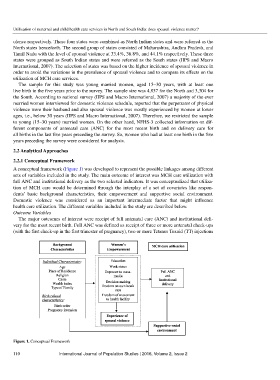
       A conceptual framework (Figure 1) was developed to represent the possible linkages among different
       sets of variables included in the study. The main outcome of interest was MCH care utilization with
       full ANC and institutional delivery as the two selected indicators. It was conceptualized that utiliza-
       tion of  MCH care would  be  determined through  the interplay of  a set  of covariates  like respon-
       dents’ basic  background characteristics, their empowerment and supportive social environment.
       Domestic violence was considered as an important intermediate factor that  might influence
       health care utilization. The different variables included in the study are described below.
       Outcome Variables
         The major outcomes of interest were receipt of full antenatal care (ANC) and institutional deli-
       very for the most recent birth. Full ANC was defined as receipt of three or more antenatal check-ups
       (with the first check-up in the first trimester of pregnancy), two or more Tetanus Toxoid (TT) injections


       Figure 1. Conceptual Framework

       110                International Journal of Population Studies | 2016, Volume 2, Issue 2

