


Page 118 - IJPS-2-2
P. 118
Utilization of maternal and child health care services in North and South India: does spousal violence matter?

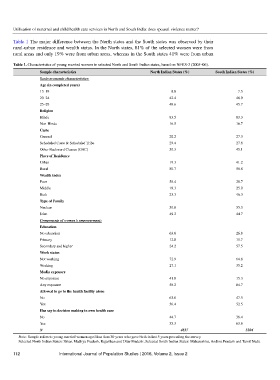
       Table 1 The major difference between the North states and the South states was observed by their
       rural-urban residence and wealth status. In the North states, 81% of the selected women were from
       rural areas and only 19% were from urban areas, whereas in the South states 41% were from urban

       Table 1. Characteristics of young married women in selected North and South Indian states, based on NFHS-3 (2005–06).
                  Sample characteristics                         North Indian States (%)     South Indian States (%)
                  Socio-economic characteristics:
                  Age (in completed years)
                  15–19                                                   9.0                         7.5
                  20–24                                                  42.4                        46.9
                  25–29                                                  48.6                        45.7
                  Religion
                  Hindu                                                  83.5                        83.3
                  Non-Hindu                                              16.5                        16.7
                  Caste
                  General                                                20.2                        27.3
                  Scheduled Caste & Scheduled Tribe                      29.4                        27.6
                  Other Backward Classes (OBC)                           50.3                        45.1
                  Place of Residence
                  Urban                                                  19.3                        41.2
                  Rural                                                  80.7                        58.8
                  Wealth index
                  Poor                                                   58.4                        28.7
                  Middle                                                 18.3                        25.0
                  Rich                                                   23.3                        46.3
                  Type of Family
                  Nuclear                                                50.8                        55.3
                  Joint                                                  49.2                        44.7
                  Components of women's empowerment:
                  Education
                  No education                                           63.0                        26.8
                  Primary                                                12.8                        15.7
                  Secondary and higher                                   24.2                        57.5
                  Work status
                  Not working                                            72.9                        64.8
                  Working                                                27.1                        35.2
                  Media exposure
                  No exposure                                            41.8                        15.3
                  Any exposure                                           58.2                        84.7
                  Allowed to go to the health facility alone
                  No                                                     63.6                        47.5
                  Yes                                                    36.4                        52.5
                  Has say in decision making in own health care
                  No                                                     44.7                        36.4
                  Yes                                                    55.3                        63.6
                  N                                                           4837                        3304
         Note: Sample refers to young married women aged less than 30 years who gave birth in last 5 years preceding the survey.
         Selected North Indian States: Bihar, Madhya Pradesh, Rajasthan and Uttar Pradesh; Selected South Indian States: Maharashtra, Andhra Pradesh and Tamil Nadu.

       112                International Journal of Population Studies | 2016, Volume 2, Issue 2

