


Page 123 - IJPS-2-2
P. 123
Atreyee Sinha and Aparajita Chattopadhyay

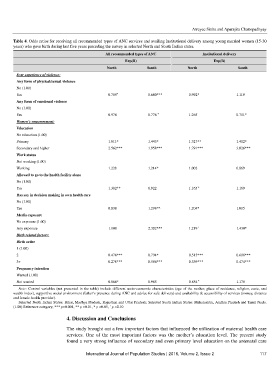
       Table 4. Odds ratios for receiving all recommended types of ANC services and availing institutional delivery among young married women (15-30
       years) who gave birth during last five years preceding the survey in selected North and South Indian states.
                                              All recommended types of ANC             Institutional delivery
                                                      Exp(B)                                Exp(B)
                                               North            South            North                South
        Ever experience of violence:
        Any form of physical/sexual violence
        No (1.00)
        Yes                                    0.789 +          0.680***         0.992*               1.119
        Any form of emotional violence
        No (1.00)
        Yes                                    0.978            0.776  +         1.265                0.701*
        Women's empowerment:
        Education
        No education (1.00)
        Primary                                1.611*           1.443*           1.327**              1.412*
        Secondary and higher                   2.562***         1.958***         1.791***             3.026***
        Work status
        Not working (1.00)
        Working                                1.228            1.214*           1.002                0.869
        Allowed to go to the health facility alone
        No (1.00)
        Yes                                    1.382**          0.922            1.165  +             1.169
        Has say in decision making in own health care
        No (1.00)
        Yes                                    0.838            1.298**          1.204*               1.015
        Media exposure
        No exposure (1.00)
        Any exposure                           1.108            2.302***         1.219  +             1.430*
        Birth related factors:
        Birth order
        1 (1.00)
        2                                      0.478***         0.794*           0.515***             0.608***
        3+                                     0.278***         0.596***         0.339***             0.474***
        Pregnancy intention
        Wanted (1.00)
        Not wanted                             0.668*           0.985            0.854  +             1.178
         Note: Control variables (not presented in the table) include different socio-economic characteristics (age of the mother, place of residence, religion, caste, and
       wealth index), supportive social environment (father’s presence during ANC and advice for safe delivery) and availability & accessibility of services (money, distance
       and female health provider).
         Selected North Indian States: Bihar, Madhya Pradesh, Rajasthan and Uttar Pradesh; Selected South Indian States: Maharashtra, Andhra Pradesh and Tamil Nadu.
                                                +
       (1.00) Reference category; *** p<0.001, ** p <0.01, * p <0.05,   p <0.10

                             4. Discussion and Conclusions
                             The study brought out a few important factors that influenced the utilization of maternal health care
                             services. One of the most important factors was the  mother’s education  level.  The present study
                             found a very strong influence of secondary and even primary level education on the antenatal care

                                     International Journal of Population Studies | 2016, Volume 2, Issue 2      117

