


Page 119 - IJPS-2-2
P. 119
Atreyee Sinha and Aparajita Chattopadhyay

                             areas and around 59% were from rural areas. Proportion  of women belonging to poor economic
                             strata was 58% in the North followed by rich (23%) and middle class (18%). Whereas, in the South
                             the situation was quite different; proportion of women belonging to upper wealth index was more
                             (46%) than the poor (29%) and middle class (25%). Regional variation in the components of wom-
                             en’s empowerment was evident from the results. Women in the South states had higher educational
                             attainment, mass  media  exposure, higher  mobility and decision making  power  compared to  the
                             North states. More than half of the women (52.5%) from the South had freedom to go to health facil-
                             ity unescorted and around  64% women could make decisions on own health care. In the North,
                             the corresponding values were 36% and 55% respectively.
                                Levels of MCH care  utilization varied  across regions where  the South states performed better
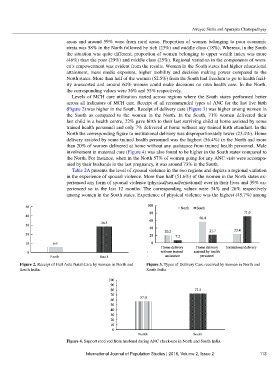
                             across  all  indicators of MCH care.  Receipt  of all  recommended types of  ANC  for the last live birth
                             (Figure 2) was higher in the South. Receipt of delivery care (Figure 3) was higher among women in
                             the South as  compared to  the women in the North.  In the South, 71% women delivered their
                             last child in a health centre, 22% gave birth to their last surviving child at home assisted by some
                             trained health personnel and only 7% delivered at home without any trained birth attendant. In the
                             North the corresponding figure to institutional delivery was disproportionately lower (23.4%). Home
                             delivery assisted by some trained health personnel was the highest (56.4%) in the North and more
                             than 20% of women delivered at home without any assistance from trained health personnel. Male
                             involvement in maternal care (Figure 4) was also found to be higher in the South states compared to
                             the North. For instance, when in the North 57% of women going for any ANC visit were accompa-
                             nied by their husbands in the last pregnancy, it was around 73% in the South.
                                Table 2A presents the level of spousal violence in the two regions and depicts a regional variation
                             in the experience of spousal violence. More than half (51.6%) of the women in the North states ex-
                             perienced any form of spousal violence (physical/sexual/emotional) ever in their lives and 39% ex-
                             perienced so  in the  last  12 months. The corresponding  values were  34% and  26% respectively
                             among women in the South states. Experience of physical violence was the highest (45.7%) among


          Figure 2. Receipt of Full Ante Natal Care by women in North and   Figure 3. Types of Delivery Care received by women in North and
          South India.                                         South India.


                             Figure 4. Support received from husband during ANC check-ups in North and South India.

                                     International Journal of Population Studies | 2016, Volume 2, Issue 2      113

